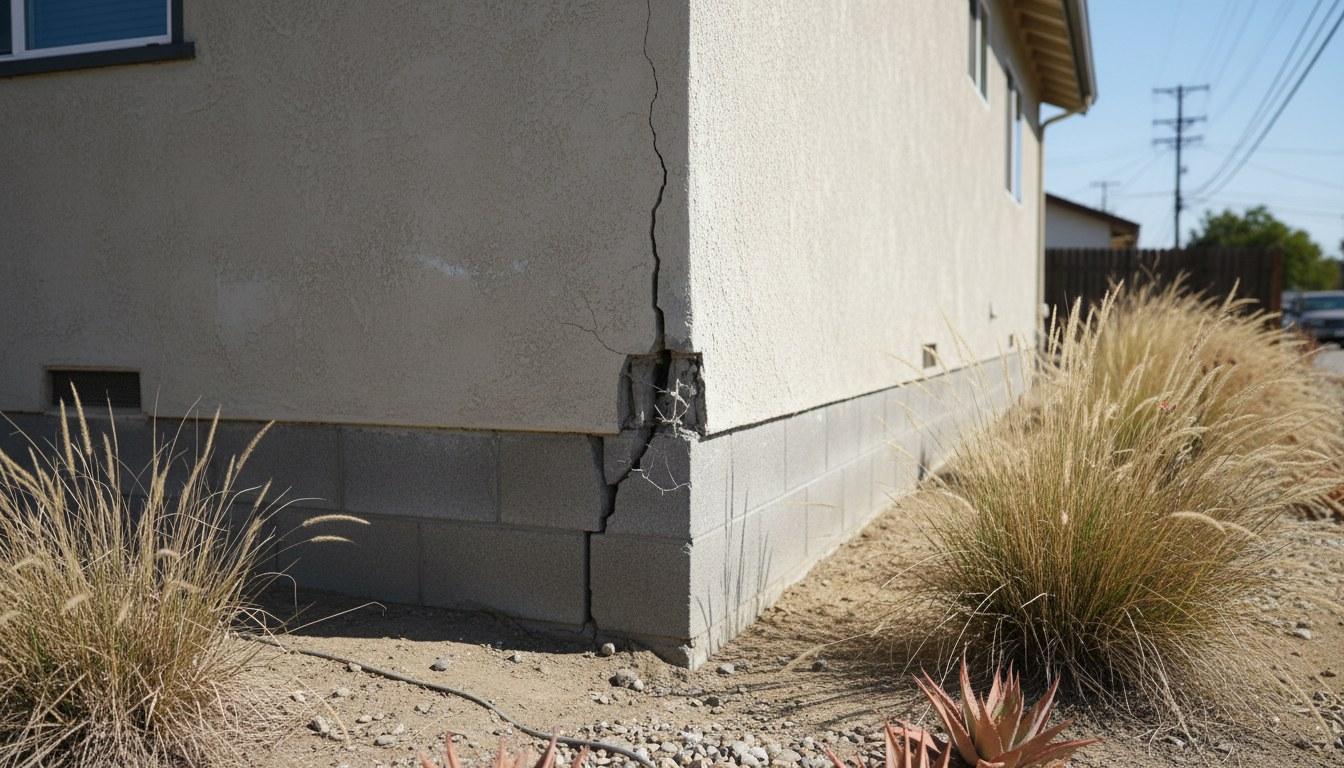
California's unique soils, seismic activity, and climate create a perfect storm for foundation damage. This guide covers the root causes, what you can do yourself, and when to call a pro.
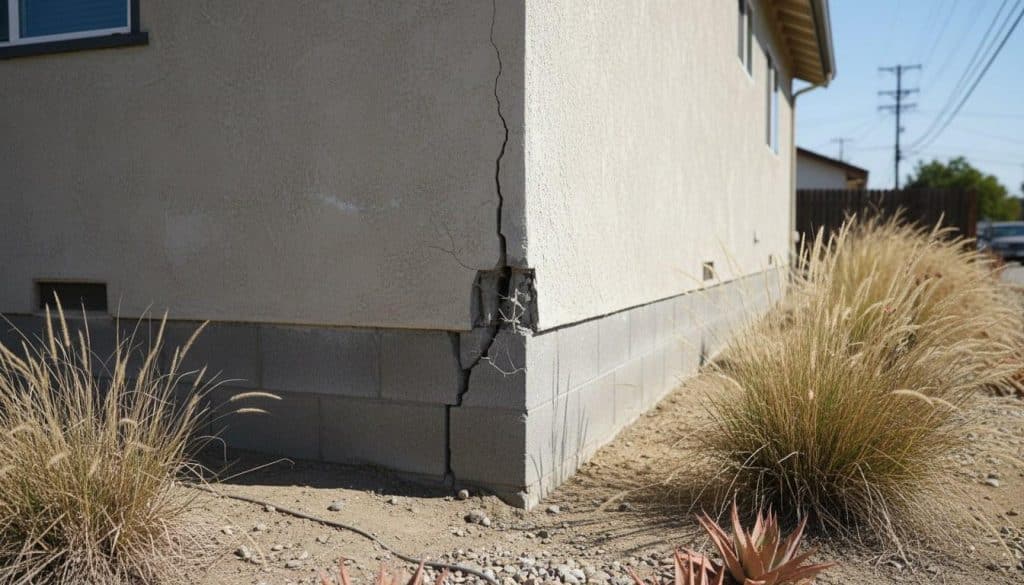
Why Are California Homes So Prone to Foundation Problems?
California’s geology, climate, and housing stock combine to make foundation damage more common here than in most other states. Expansive soils, seismic activity, and seasonal drought-to-rain cycles all stress concrete and wood foundations year after year. Understanding why these forces exist is the first step toward protecting your home.
Much of Southern California and the Central Valley sits on seismically active ground. Even minor tremors — many below the 3.0 magnitude threshold homeowners feel — can shift a slab or crack a stem wall over time. Add to that the region’s clay-heavy soils, which swell when wet and shrink when dry, and you have a foundation that is constantly being pushed and pulled.
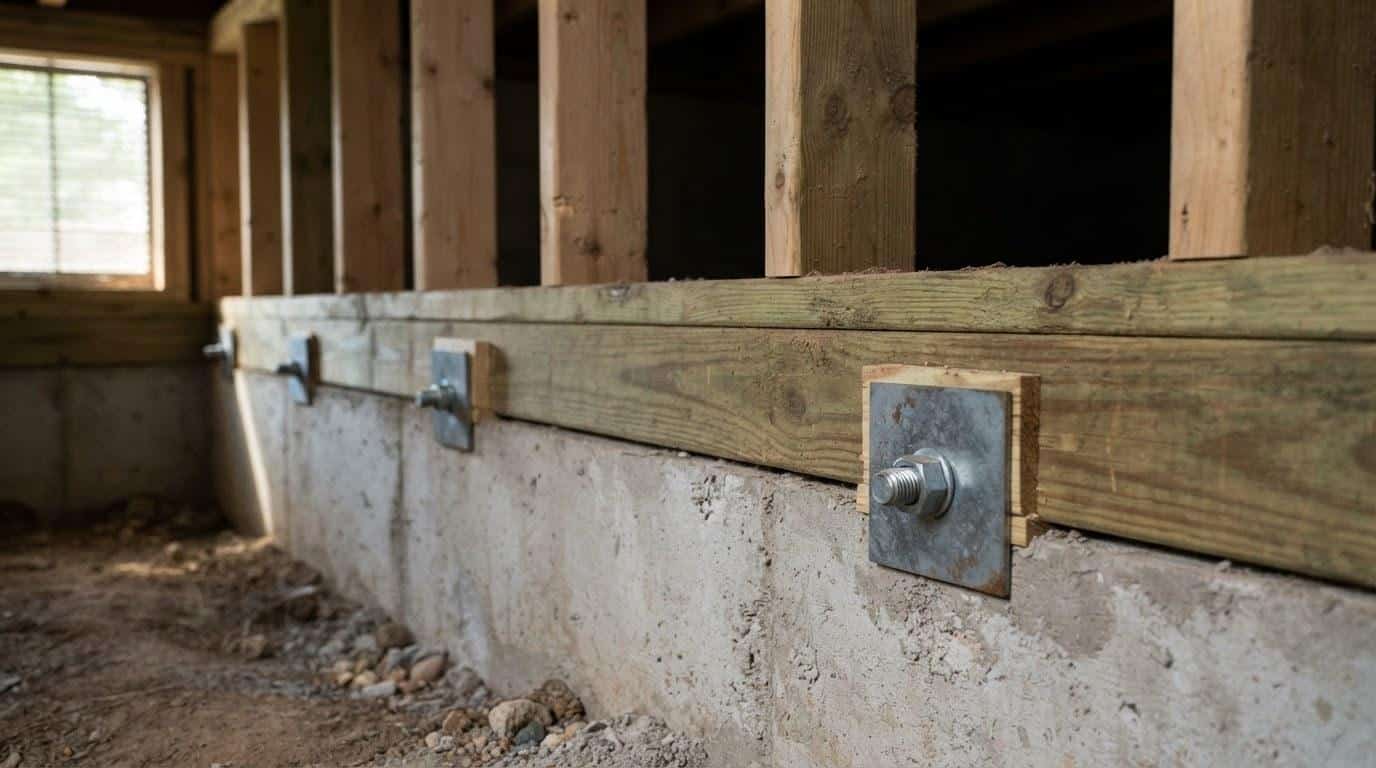
California’s housing stock adds another layer of risk. A large share of homes across Los Angeles County and surrounding areas were built before 1980, before modern seismic retrofit codes required bolting sill plates and bracing cripple walls. Those older structures are especially vulnerable.
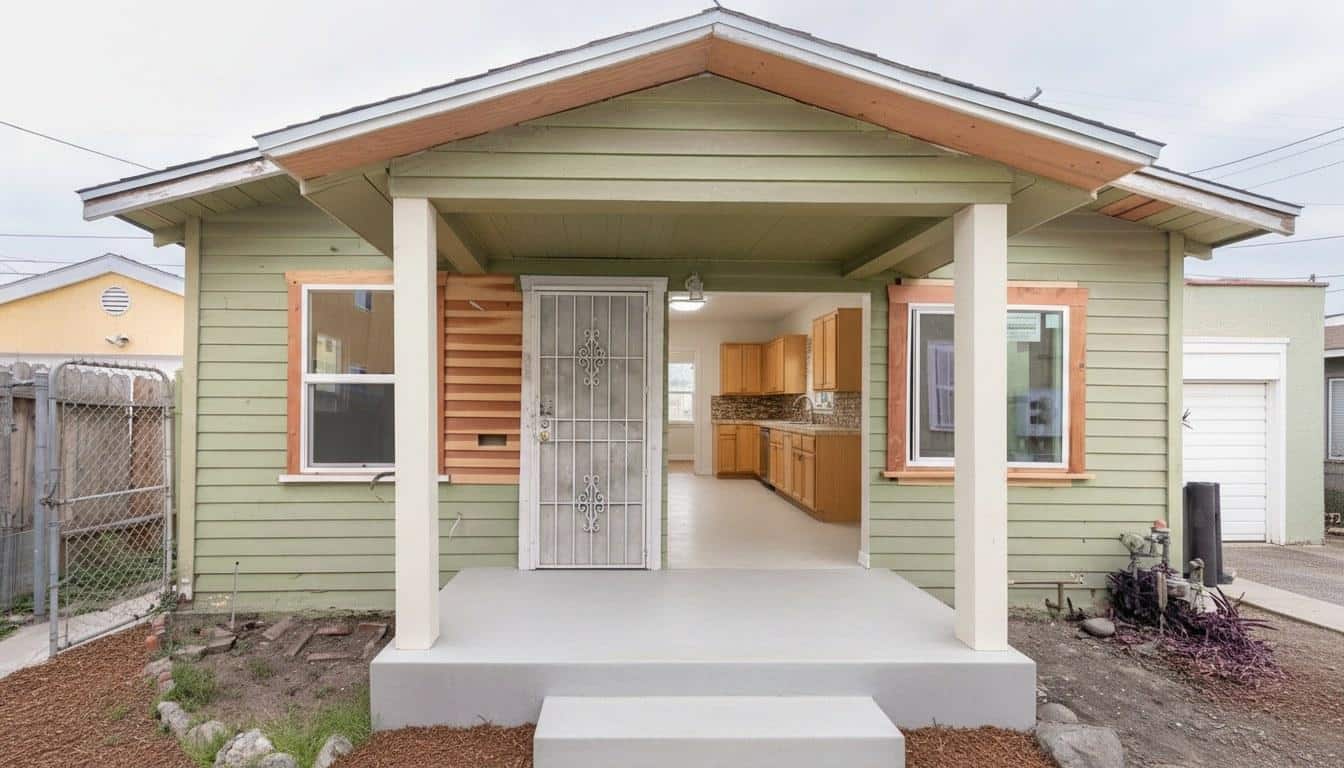
What Are the Most Common Causes of Foundation Problems in California Homes?
The causes of foundation problems in California homes fall into five main categories: soil movement, water intrusion, seismic stress, biological factors, and construction defects. Most foundation failures involve more than one of these at the same time.
Expansive Clay Soils
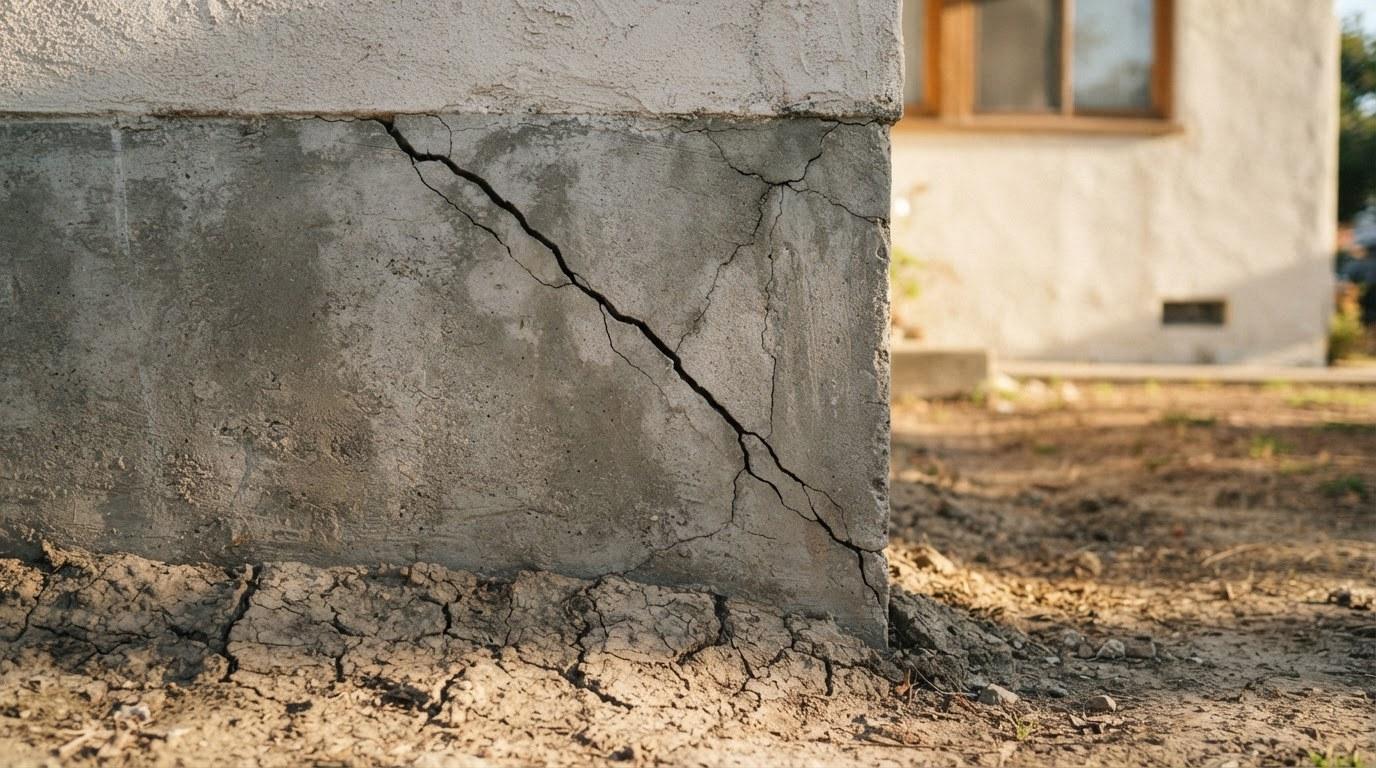
Clay soil is the number one driver of foundation movement across California. When clay absorbs water, it can expand by up to 10 percent in volume. When it dries out — which happens fast during Southern California’s long dry seasons — it contracts and pulls away from the foundation. This repeated cycle cracks concrete slabs, separates stem walls, and causes uneven settling.
The USDA Web Soil Survey maps expansive soil zones across California. Many communities in Los Angeles County, the Inland Empire, and the San Fernando Valley sit directly on high-shrink-swell clay.
Poor Drainage and Water Intrusion
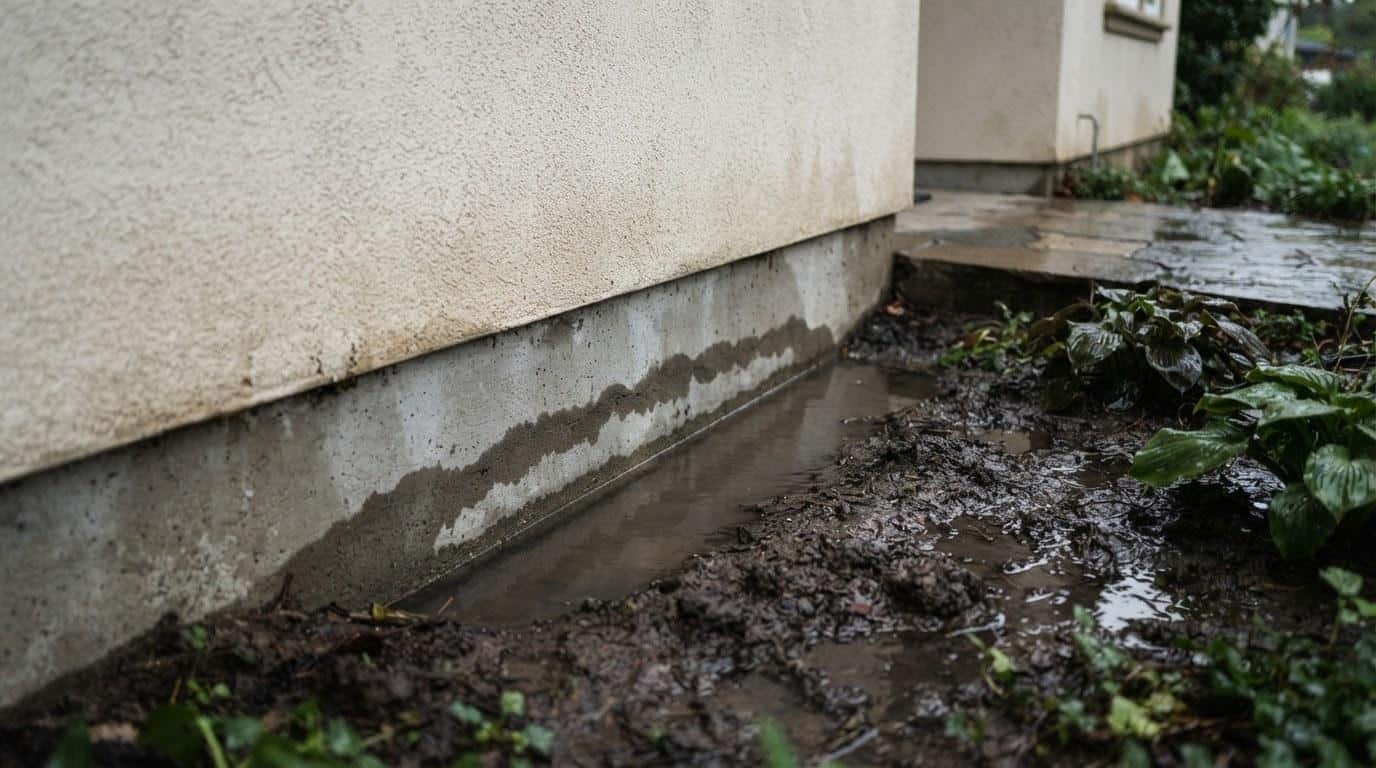
Water that pools against a foundation or flows beneath a slab softens the soil and erodes the base the foundation rests on. Gutters that discharge too close to the house, grading that slopes toward the structure, and broken irrigation lines are frequent culprits. In communities across Southern California, we see drainage problems trigger foundation movement within 3 to 5 years of the original water source going unrepaired.
Seismic Activity
California averages hundreds of small earthquakes every month. Larger events — magnitude 5.0 and above — can crack stem walls, shear anchor bolts, and shift post-and-pier foundations. Homes without seismic retrofits are at the highest risk. California’s Brace + Bolt program offers grants for seismic retrofits on qualifying older homes, which directly reduces foundation risk.
Tree Root Intrusion
Mature trees planted within 10 to 15 feet of a foundation can send roots beneath the slab. Those roots draw moisture from the soil unevenly, causing differential settling — one side of the foundation drops while the other stays put. Eucalyptus, ficus, and willow trees are particularly aggressive and common across Southern California neighborhoods.
Construction Defects and Age
Homes built before California’s 1994 post-Northridge seismic code updates often lack adequate steel reinforcement in the slab or stem wall. Shallow footings, undersized piers, and inadequate rebar spacing all reduce a foundation’s ability to handle soil movement. As concrete ages past 40 to 50 years, it also becomes more porous and susceptible to cracking from freeze-thaw cycles in higher-elevation communities.
What Are the Warning Signs Your Foundation Needs Attention?
Foundation damage rarely announces itself with a single dramatic crack. It usually shows up as a slow accumulation of small symptoms across the house. Catching these early — before the damage spreads to framing, drywall, and plumbing — can save tens of thousands of dollars in repair costs.
- Diagonal cracks at door and window corners: Stair-step cracks radiating from the corners of openings are a classic sign of differential settling.
- Doors and windows that stick or won’t latch: When a foundation shifts, door frames rack out of square, making doors and windows bind.
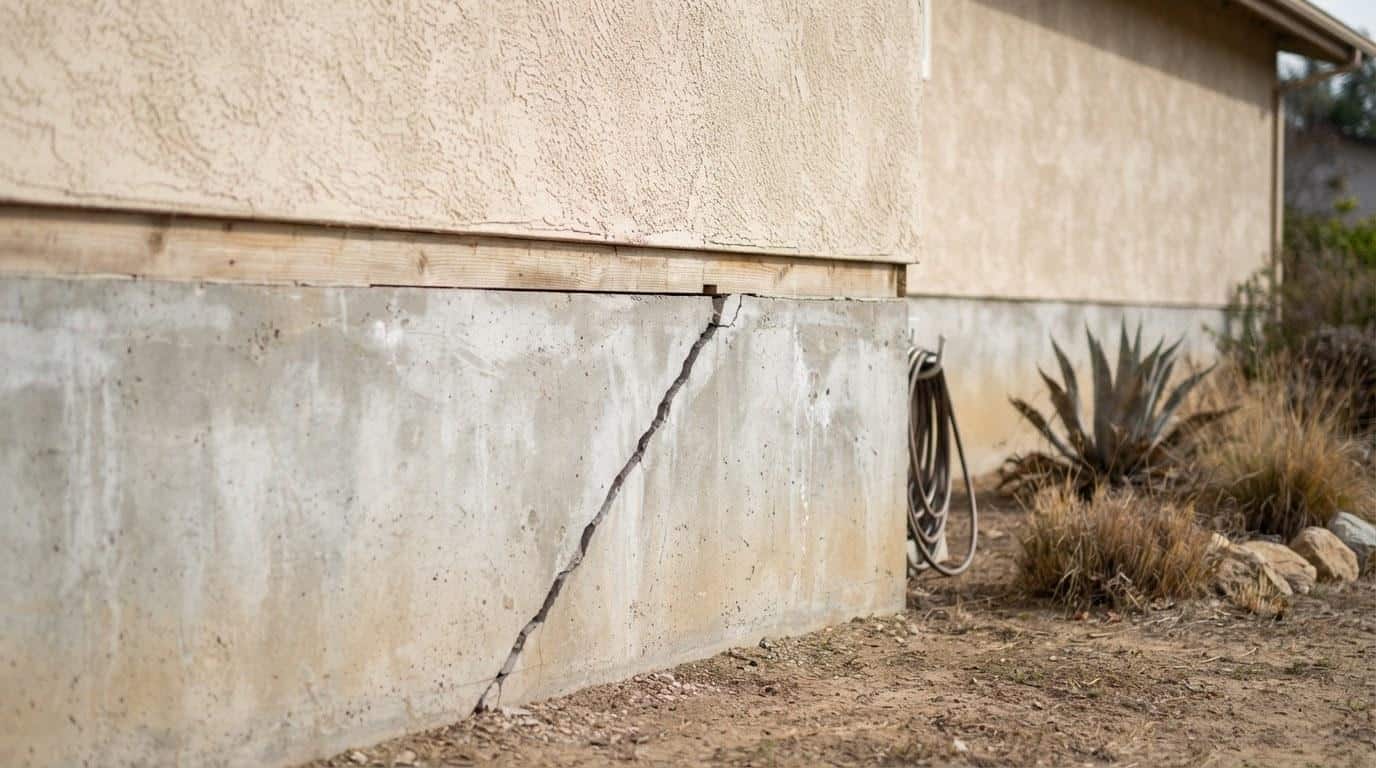
- Visible cracks in the slab or stem wall: Horizontal cracks in stem walls are especially serious — they often indicate soil pressure pushing inward.
- Uneven or sloping floors: A floor that tilts more than 1 inch over 10 feet is a red flag for significant settling.
- Gaps between walls and the ceiling or floor: Separation at these joints shows the structure is moving in ways the finish materials cannot accommodate.
- Bowing or leaning exterior walls: Walls that visibly lean outward or inward point to foundation movement or soil pressure.
- Moisture or efflorescence in the crawl space: White chalky deposits on concrete indicate water is moving through the foundation material.
- Chimney separation: A chimney that pulls away from the main structure by even half an inch signals that the foundation beneath it has shifted.
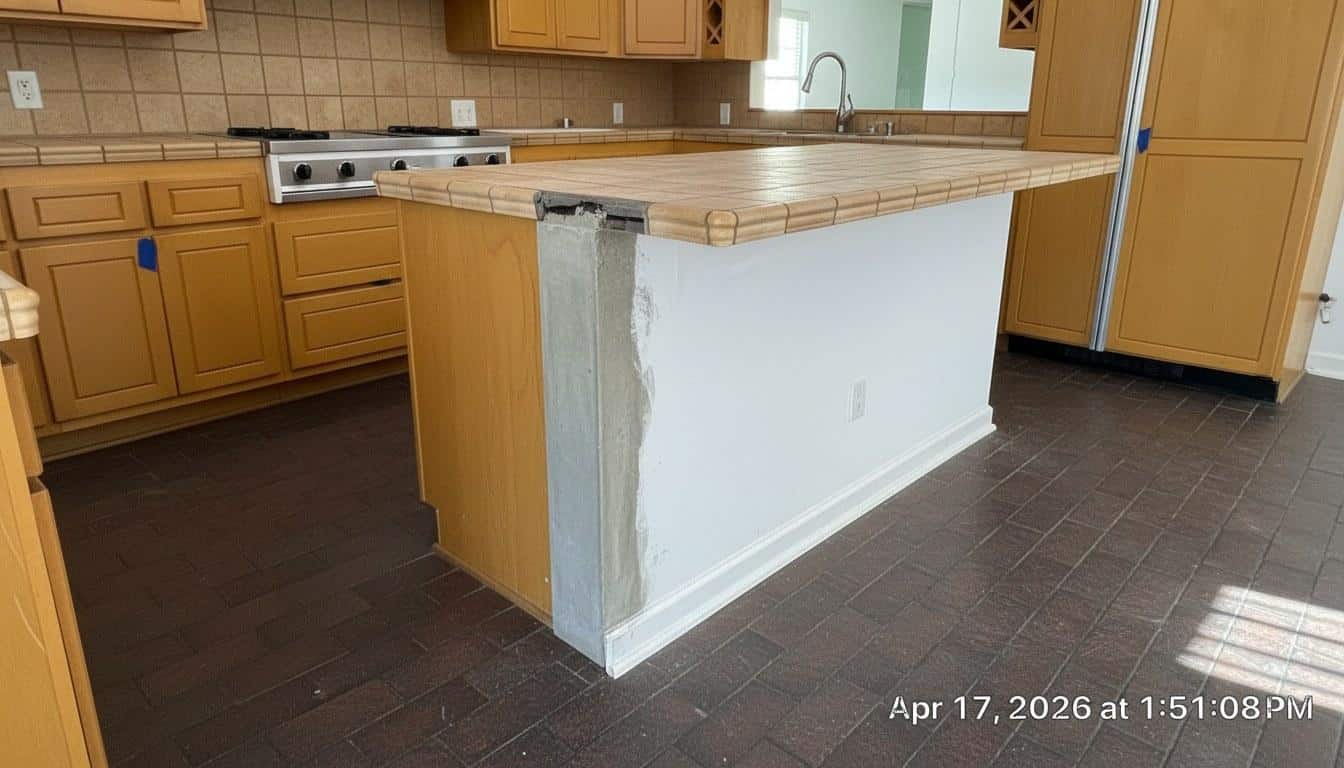
Symptom, Likely Cause, and What to Do — At a Glance
| Symptom | Likely Cause | DIY or Pro? |
|---|---|---|
| Diagonal cracks at window/door corners | Differential settling from soil movement | Pro — needs structural assessment |
| Sticking doors or windows | Frame racking from foundation shift | Pro — monitor first, then inspect |
| Horizontal stem wall cracks | Lateral soil pressure against the wall | Pro immediately — high risk |
| Sloping floors (over 1 inch per 10 feet) | Pier or post settling, slab subsidence | Pro — requires elevation survey |
| Hairline slab cracks (under 1/8 inch) | Normal concrete curing shrinkage | DIY monitoring — seal with epoxy filler |
| Efflorescence (white powder) on concrete | Water migrating through the foundation | DIY drainage fix first; Pro if recurring |
| Chimney pulling away from house | Isolated footing settling | Pro — chimney and foundation work needed |
| Gaps at ceiling or floor line | Structural movement, framing separation | Pro — may involve multiple systems |
What Can You Check Yourself?
Homeowners can safely do a visual inspection, measure floor slope, and address surface drainage without any special equipment. These steps help you understand the severity of the problem before calling a foundation repair company.
- Walk the perimeter of the house. Look for cracks wider than 1/4 inch in the stem wall or slab edge. Note whether cracks run horizontally, vertically, or diagonally — the direction matters for diagnosis.
- Check your grading. The ground should slope away from the foundation at least 6 inches over the first 10 feet. Use a long level or a line level and string to check. If the grade runs toward the house, it is directing water straight to the foundation.
- Inspect gutters and downspouts. Make sure downspouts discharge at least 4 to 6 feet from the foundation. Extensions are inexpensive and can eliminate a major water source.
- Measure floor slope with a simple level. Place a 4-foot level on the floor in multiple rooms. A bubble that reads more than 1/2 inch off center across 4 feet warrants a professional elevation survey.
- Check the crawl space for moisture. If your home has a crawl space, use a flashlight to look for standing water, wet soil, or white efflorescence on the piers. A moisture reading above 19 percent in wood members signals a problem.
- Look for tree roots near the foundation. Surface roots within 10 feet of the house are a sign that subsurface roots may already be beneath the slab.
- Mark and date any cracks. Use a pencil to draw a line at each end of a crack and write the date. Check back in 30 days. If the crack has grown past your marks, it is active — call a pro.
When Should You Call a Foundation Repair Professional?
Call a licensed foundation repair contractor immediately if you see horizontal cracks in a stem wall, floors sloping more than 1 inch over 10 feet, or any wall that visibly leans. These are structural emergencies that go beyond what a homeowner can safely evaluate or repair.
Beyond the emergency signs, you should schedule a professional inspection if cracks are growing, if doors or windows have started sticking in the past 6 to 12 months, or if you are planning to sell the home. California real estate disclosure law requires sellers to report known foundation defects, and an undisclosed problem discovered during escrow can kill a sale.
Foundation repair professionals use tools homeowners do not have access to: elevation surveys accurate to 1/100 of an inch, ground-penetrating radar to map soil voids, and hydraulic equipment to drive steel piers 15 to 25 feet into stable soil. These methods go far beyond what any DIY approach can accomplish.
Make sure any contractor you hire is Licensed by the California Contractors State License Board (CSLB). Foundation work in California requires a C-61 specialty license or a General Engineering (A) license. You can verify a license at cslb.ca.gov.
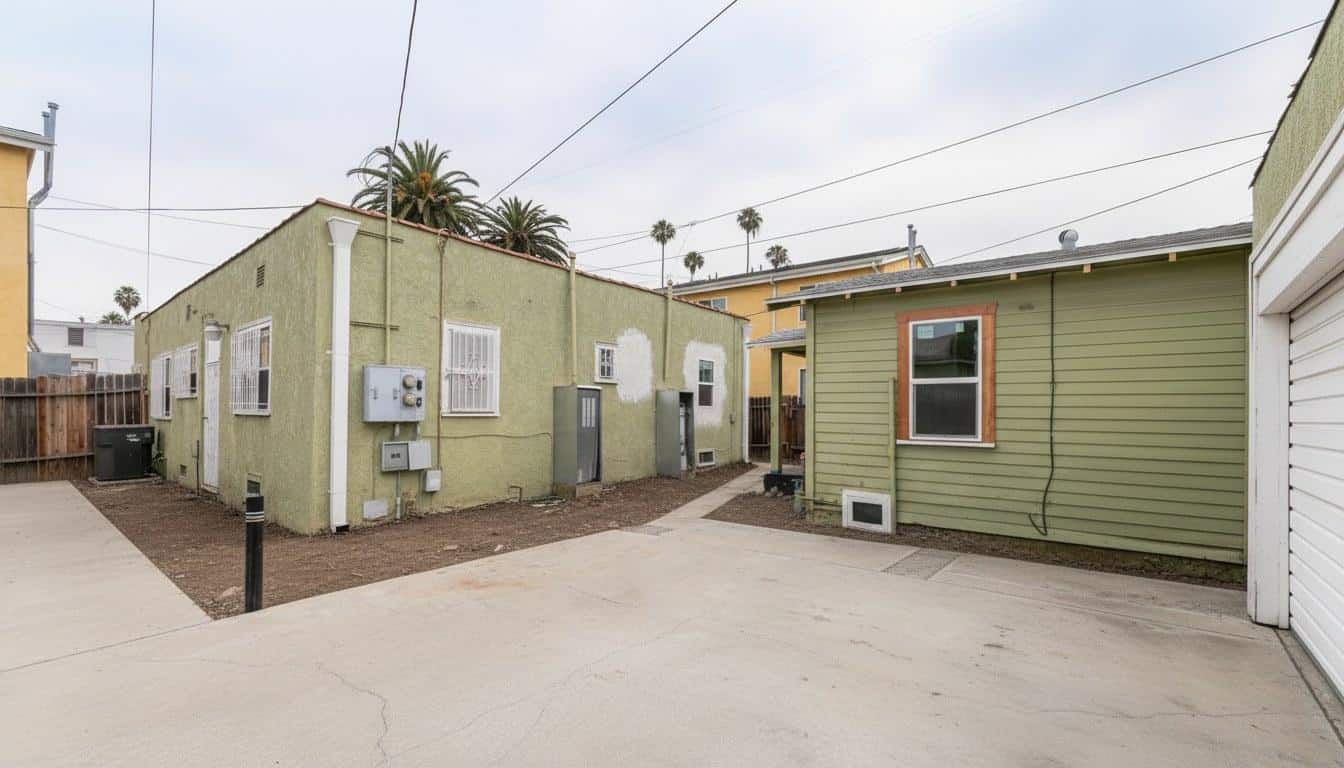
Our technicians have responded to over 200 foundation assessments across Los Angeles County in the past two years alone, and roughly 65 percent of those calls involved at least two root causes working together — most commonly expansive soil combined with a drainage defect that had gone unaddressed for several years.
What Does Foundation Repair Cost in California?
Foundation repair in California typically ranges from $2,500 for minor crack injection to $30,000 or more for full pier systems on a large home with significant settling. The biggest factors are the type of repair needed, the number of piers or anchors required, and the accessibility of the foundation.
| Repair Type | Typical Market Range (CA) | Key Cost Drivers |
|---|---|---|
| Epoxy or polyurethane crack injection | $500 – $3,500 | Number and length of cracks, access |
| Drainage correction and regrading | $1,500 – $6,000 | Yard size, depth of French drain, soil type |
| Crawl space encapsulation and pier repair | $4,000 – $12,000 | Square footage, number of piers, moisture level |
| Steel push pier or helical pier installation | $1,200 – $2,500 per pier | Depth to stable soil, number of piers, site access |
| Seismic retrofit (cripple wall bracing + bolting) | $3,000 – $10,000 | Home size, crawl space height, existing anchor bolts |
| Full slab leveling (mudjacking or foam lifting) | $3,000 – $15,000 | Slab area, void depth, soil conditions |
Several factors push costs toward the higher end of these ranges: homes on steep hillsides (common across Los Angeles County), properties with limited access for equipment, and cases where the foundation damage has already spread to the framing or plumbing. Getting a written, itemized quote before any work begins is essential.
As of 2024, California’s Brace + Bolt program provides grants of up to $3,000 for qualifying homeowners to seismically retrofit older wood-frame homes. Income limits and eligibility vary by county. Check current availability through the California Residential Mitigation Program.
On the federal side, the Inflation Reduction Act federal tax credit does not directly cover foundation repair, but energy-efficiency improvements made alongside a foundation project — such as crawl space insulation or vapor barriers — may qualify for separate credits under the residential energy efficiency provisions. Consult a tax professional for your specific situation.
We see the causes of foundation problems in California homes most clearly in properties that deferred maintenance for 5 or more years — in those cases, repair costs are typically 3 to 4 times higher than they would have been at the first sign of trouble.
Get Expert Foundation Help Today
Foundation problems do not fix themselves, and waiting even one rainy season can turn a manageable crack into a structural repair that costs tens of thousands of dollars. If you have noticed any of the warning signs covered in this guide, the smart move is to get a professional assessment now.
Hollywood Contractor Corp works with homeowners across Southern California to diagnose and repair foundation problems — from drainage corrections and crawl space repairs to full pier systems and seismic retrofits. Our team provides written, itemized quotes so you know exactly what the work involves before anything begins.
Call (818) 264-1955 to schedule your foundation inspection. Do not wait for the next rainstorm to make the decision for you.
Explore our full range of General Contracting services.
Frequently Asked Questions
How much does it usually cost to repair a house foundation in California?
Foundation repair in California typically ranges from $2,500 for minor crack injection to $30,000 or more for a full pier system on a home with significant settling. The cost depends on the type of repair, the number of piers or anchors needed, and how accessible the foundation is. Getting a written, itemized quote from a licensed contractor is the best way to know your actual cost. Call Hollywood Contractor Corp at (818) 264-1955 to request a custom assessment.
How do I know if my foundation problems are serious or just cosmetic?
Hairline cracks under 1/8 inch wide are usually cosmetic and result from normal concrete curing. Cracks wider than 1/4 inch, horizontal cracks in stem walls, or floors that slope more than 1 inch over 10 feet are serious structural warning signs. If cracks are growing — measurable over 30 days — you should call a licensed foundation repair contractor right away. Waiting typically makes the repair more expensive.
What is the most common cause of foundation problems in California homes?
Expansive clay soil is the single most common cause of foundation problems in California homes. Clay swells when it absorbs water and shrinks when it dries out, creating a push-pull cycle that cracks concrete and causes differential settling. Poor drainage that directs water toward the foundation makes clay soil movement significantly worse. Seismic activity is a close second cause, especially for homes built before 1994.
Can I repair a foundation crack myself?
Hairline cracks under 1/8 inch wide can be sealed with a DIY epoxy or polyurethane crack filler available at hardware stores. However, any crack wider than 1/4 inch, any horizontal crack, or any crack that is actively growing should be evaluated by a licensed structural contractor before you attempt a repair. Sealing a crack without fixing the underlying cause — such as poor drainage or soil movement — will not stop the damage.
How long does foundation repair take?
Simple crack injection repairs typically take 1 to 2 days. Drainage corrections and regrading usually take 2 to 4 days depending on yard size. A full pier installation for a settling home can take 3 to 7 days, depending on the number of piers and site access. Most foundation repair contractors will give you a project timeline in writing as part of your quote. Hollywood Contractor Corp provides clear timelines before any work begins — call (818) 264-1955 for details.