A hillside Los Angeles home with a heavily patched flat roof turned out to have decayed timber under several penetrations, a full tear-off and rebuild was the only real fix.
A Roof You Could Read From the Patches
 flat roof covered in dozens of black mastic patches around pipe penetrations before replacement”>
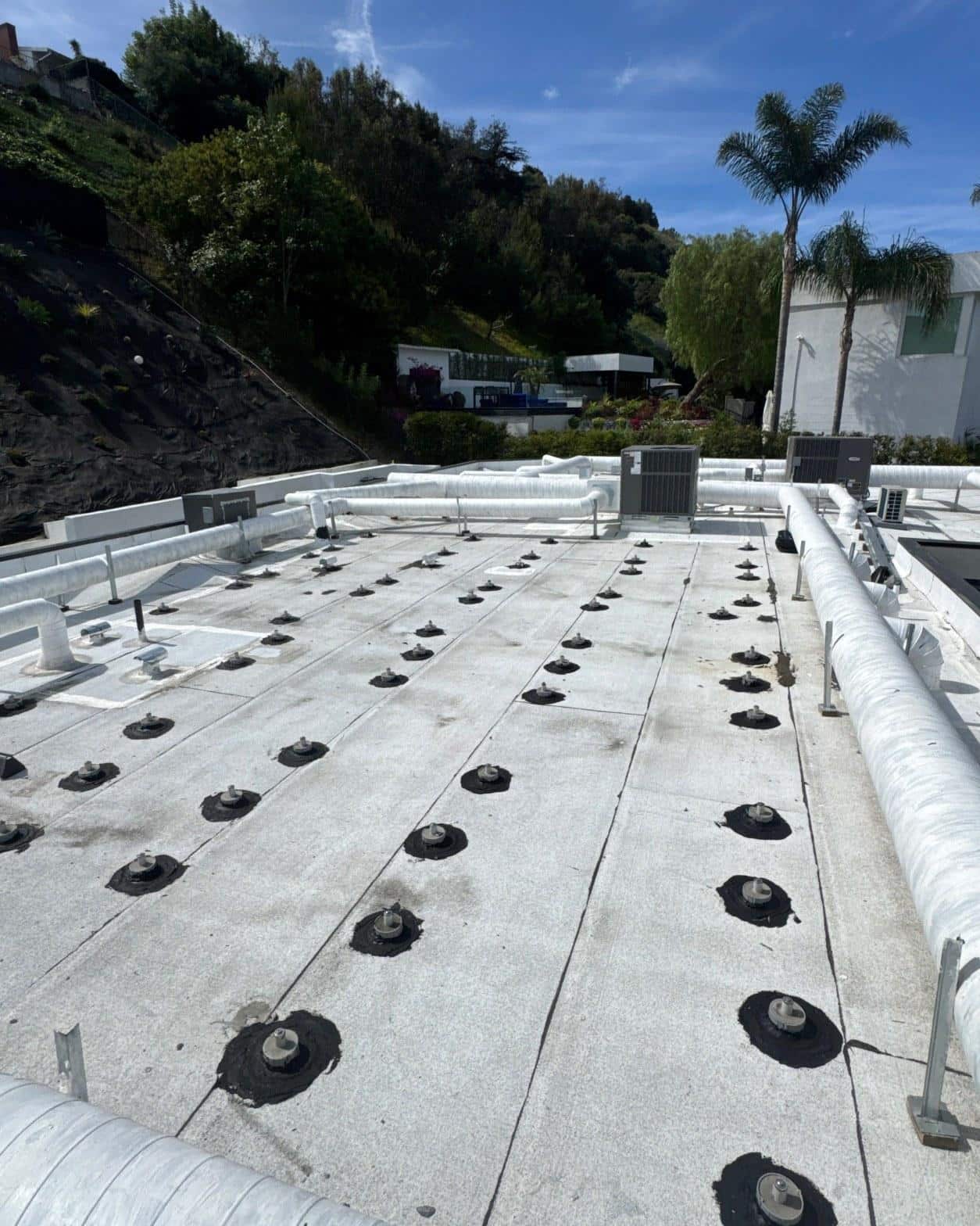
When you stepped onto this Los Angeles roof for the first time, you did not need a moisture meter to know something was wrong. You could read it from the patches. Dozens of pipe penetrations dotted the surface of the low-slope deck, each one ringed with black mastic, and fine cracks ran through the white coating between them. The house sat on a hillside lot, almost entirely covered by a single large flat plane of roof carrying multiple rooftop air-conditioning units and long runs of insulated pipework. That combination meant a lot of things coming through the membrane, and a lot of places where the membrane had been asked to do more than it was designed to do.
The homeowner had been through this before. A patch here, a patch there, each one solving an immediate drip. What the patches had never solved was the question underneath: how much time had water spent in the deck between the moment it got past the original seal and the moment somebody noticed it inside?
The patches were doing something important even before anyone opened them up. They were acting as a record. Each black ring of mastic marked a location that had already failed once. A roof with one patch is a roof that had a problem. A roof with patches in every direction is a roof that has been failing in stages for a long time, and the intervals between those stages are exactly when water was moving through timber it had no business touching.
The setting mattered too. A hillside property in Los Angeles means the roof carries equipment, and equipment means penetrations. The Los Angeles basin climate is mild enough that homeowners sometimes underestimate how much thermal cycling a flat roof membrane endures between warm afternoons and cool nights, particularly at elevation. That cycling works on every seal, every joint, and every ring of mastic around every pipe, year after year.
Where Do Low-Slope Roofs Actually Fail?
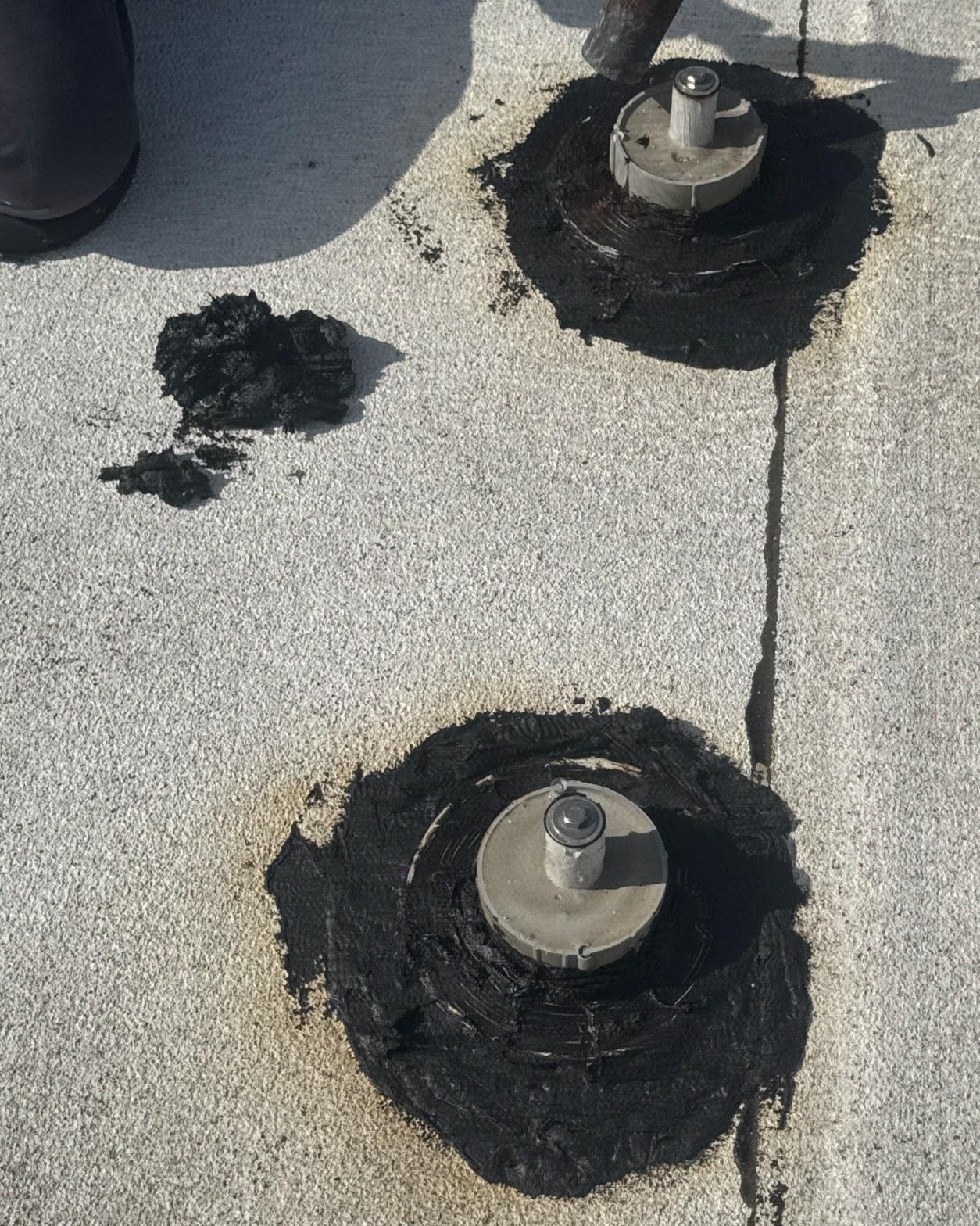
A flat roof almost never fails in the open middle of the deck, away from any obstruction. It fails where something interrupts the membrane: a pipe, a vent, a conduit, an equipment curb, an anchor bolt. Each of those points is a place where the continuous sheet of waterproofing has to be cut, fitted, and sealed around an object that moves at a different rate than the roof itself when temperatures change.
On a plain residential flat roof with no equipment, there may be only a handful of penetrations: a plumbing vent or two, perhaps a conduit. On a house like this one, with multiple rooftop HVAC units and the associated pipework running back across the deck, the count climbs into dozens. That is not a criticism of how the house was built. It is simply a description of the maintenance proposition. More penetrations means more perimeter to seal, more places for a seal to age out, and more places where a small failure can sit quietly for a season before it shows up as a stain on a ceiling below.
As of 2026, California’s Title 24 building energy standards place requirements on roof assembly performance, but no code requirement changes the physics of a rubber or felt seal aging around a metal pipe over many years. The seal will eventually need to be renewed, and the question is always whether it is renewed as part of a planned program or discovered after water has already moved into the structure.
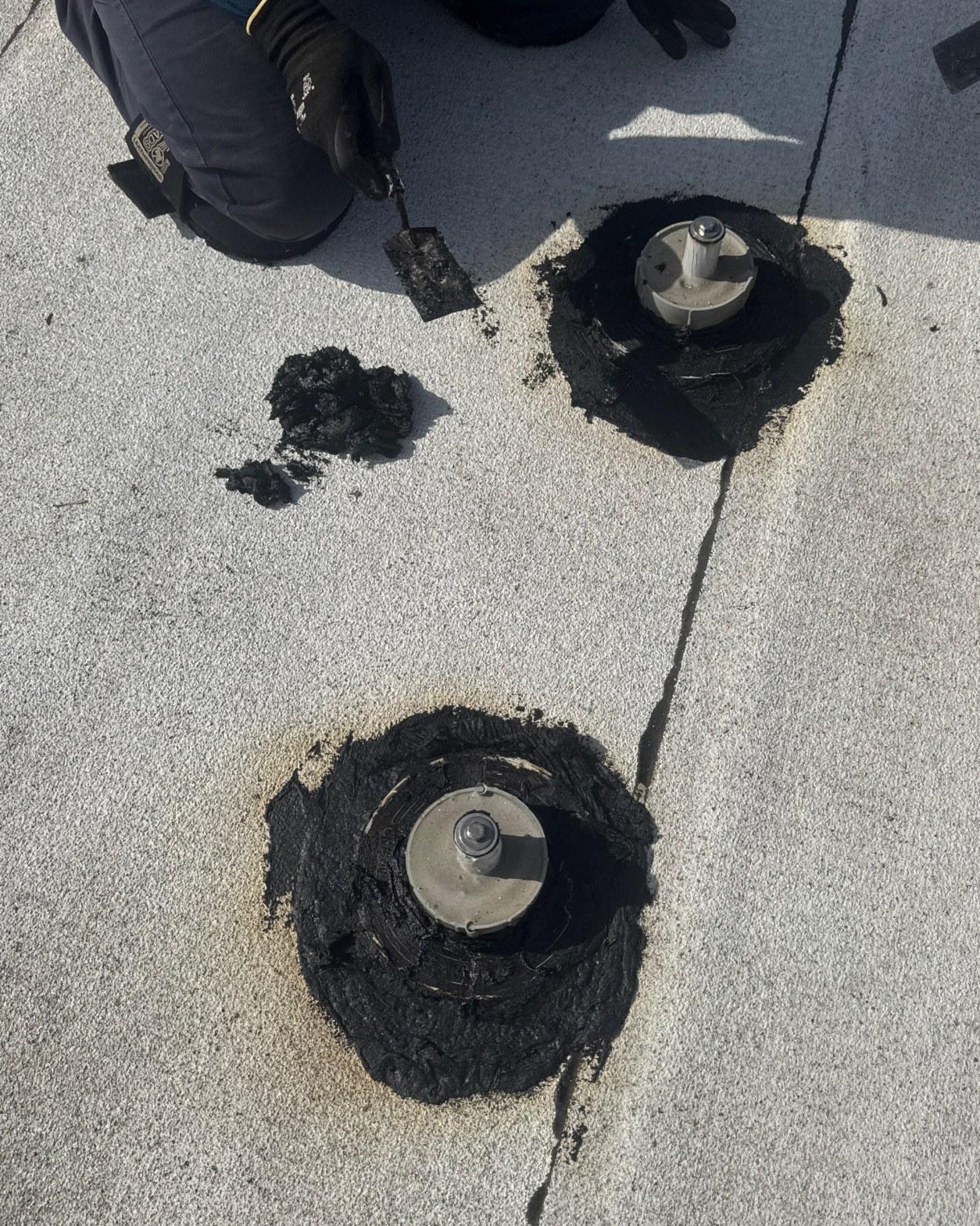
The mastic patches visible on this roof are a textbook example of the second path. At close range, the cracking around the penetrations was obvious: the coating had dried, contracted, and pulled away from the base of each fitting. Some patches had been applied over earlier patches, which is a sign that the first repair had not held long enough. Each reapplication is thinner than the one before it and more brittle with age. The seal holds for a season, then for a few months, then for a matter of weeks.
Our team sees this pattern on roofs where the penetrations have never had proper flashing, only successive coats of mastic. The mastic itself is not the wrong material; it is the wrong substitute for a correctly detailed membrane termination. A flashing integrates with the membrane below it and creates a continuous barrier. Mastic sits on top of the membrane and relies entirely on adhesion, which is why it fails first at the edges, which is exactly where water is trying to enter.
Mastic Is a Seal, Not a Flashing
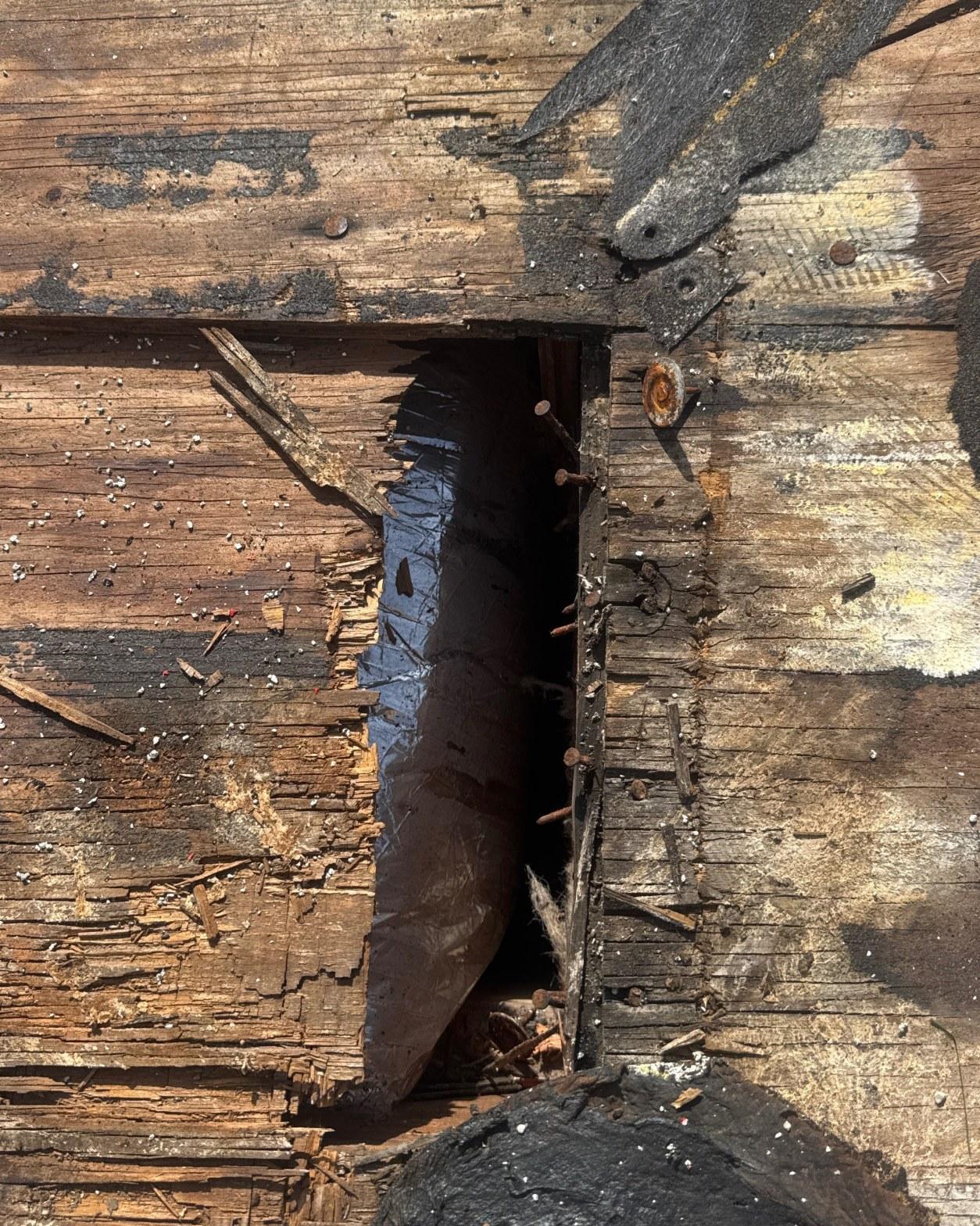
The difference between mastic and flashing is not a matter of quality; it is a matter of what job each one is doing. A proper penetration detail wraps the membrane material up around the pipe, bonds it, and terminates it at a point above the waterline. The membrane is doing the waterproofing. Mastic applied over the top of a penetration is a sealant sitting on the surface, exposed to UV and thermal movement, with no mechanical connection to the deck below.
The field of a roofing membrane is designed to last for a good many years under normal conditions. A mastic repair, particularly one applied in the field rather than installed as part of a specified system, has a far shorter life before it begins to crack and lift at the edges. That gap is where the problem lives. The membrane underneath a repaired penetration may still be intact. The mastic holding the repair closed may have been failing for two or three seasons. The water does not announce itself.
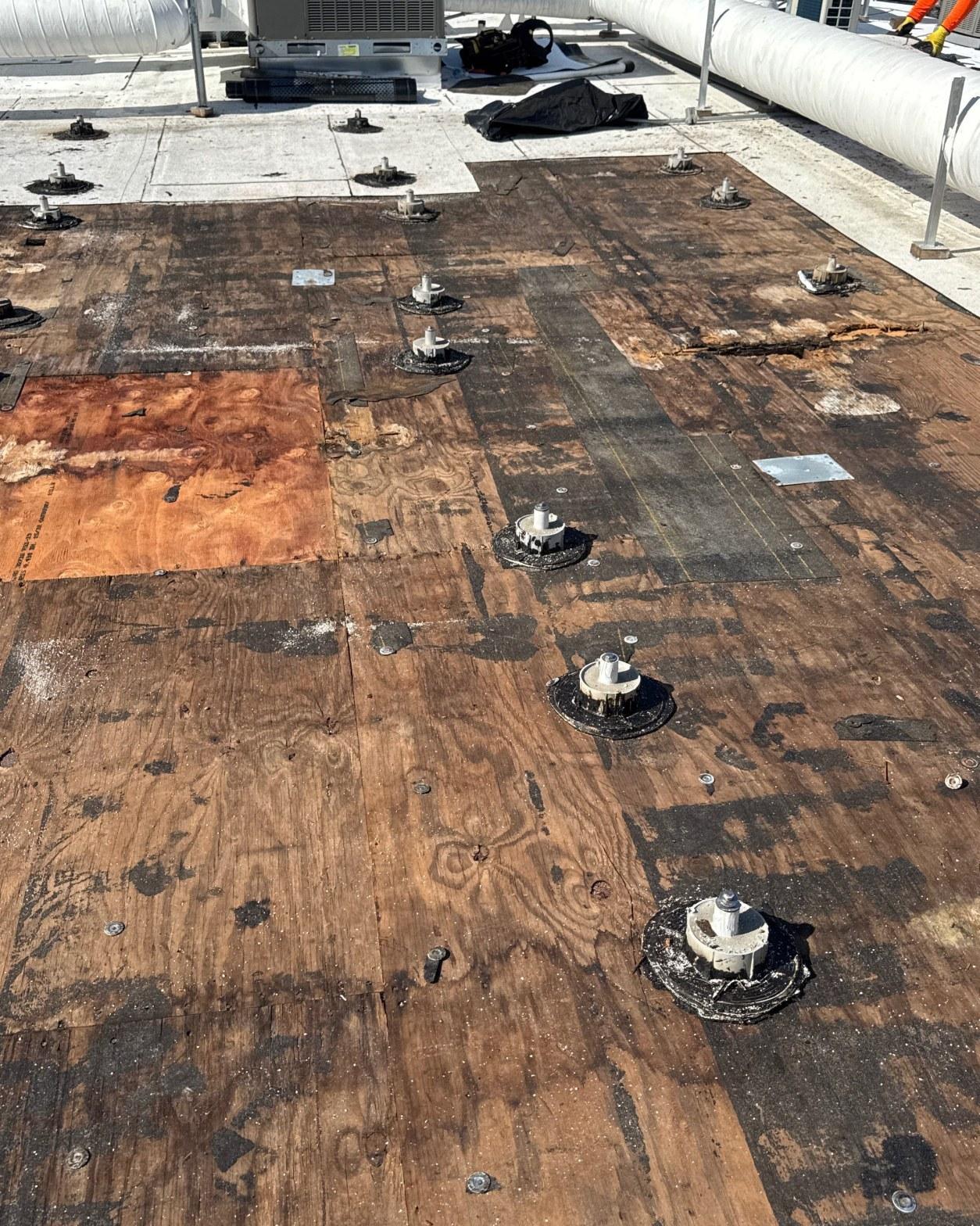
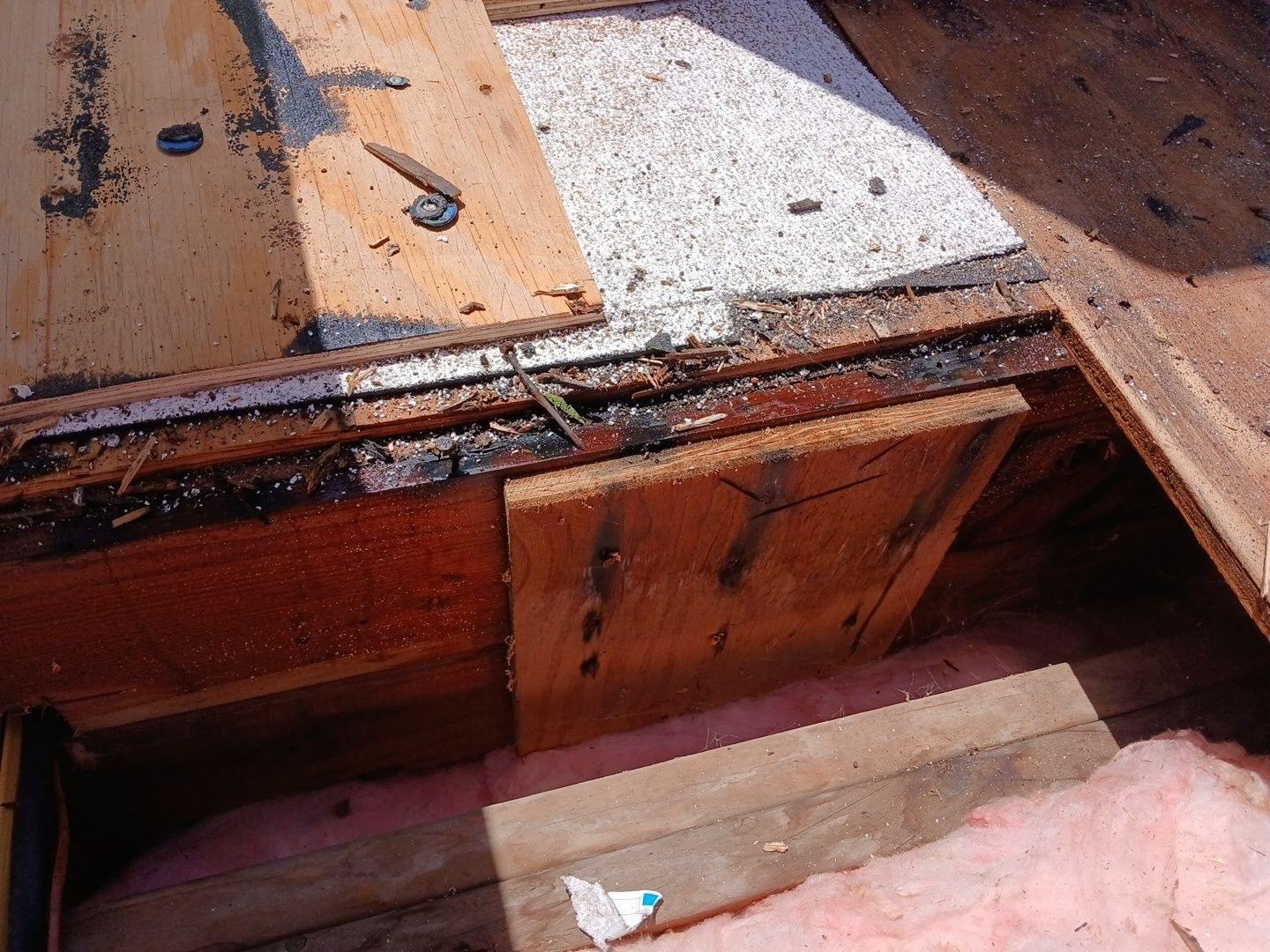
When the patches on this Los Angeles roof were opened up, the timber told the story. Around several penetrations, the deck boards had softened and splintered. Where the mastic ring had cracked even slightly, water had found a path down the pipe and into the wood beneath. The decay was not visible from the surface; the patch had hidden it. What you could see was intact white coating. What was underneath was timber that had absorbed enough moisture over enough seasons to lose its structural integrity entirely.
This is the argument for opening a patched roof rather than patching it again. The patch can look solid from the top. The question it cannot answer is what happened in the weeks or months before the last person sealed it, and what has been happening in the wood since.
What We Found When the Deck Came Off
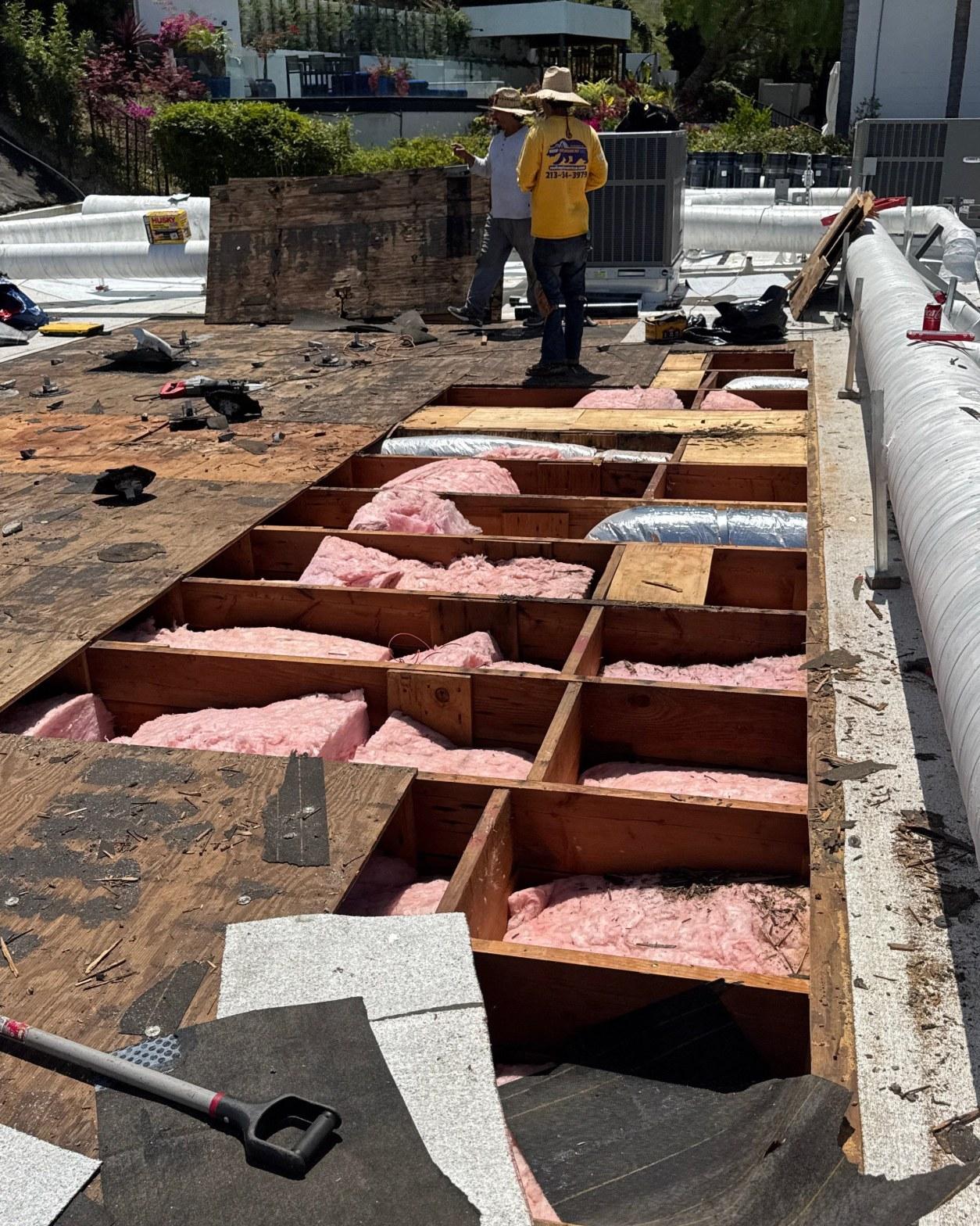
Stripping the old surface back to the deck confirmed what the number of patches had suggested: the damage was not limited to the membrane. In several areas, decking boards had to be cut out entirely. The joists beneath them were exposed, and the pink fiberglass insulation between the framing bays came into view across a wide section of the roof.
Replacing deck boards is straightforward work, but it cannot be done without first removing the membrane above and it cannot be skipped. A new membrane laid over soft or water-damaged decking will follow the shape of the deck beneath it, pooling in depressions and placing stress on seams in the same locations where the old seams failed. The substrate has to be solid before anything goes on top of it.
The extent of the deck replacement on this job was visible proof of something worth saying plainly to any homeowner with a patched flat roof: the cost of the patch is not the cost of the repair. The patch pays for the material and the labor to apply it. The repair pays for everything the water did while the patch was holding, plus the patch itself, plus the new membrane, plus the new deck boards. The longer the patch holds, the larger that second bill tends to be, because water in timber does not stop moving once it finds a path in.
Cutting out the damaged sections and fitting new deck boards brought the substrate back to a consistent, solid plane. That is the starting point for any membrane that is going to perform for its full intended life. With the framing sound and the new decking in place, the roof was ready for the membrane.
Rebuilding the Deck and Laying the New Membrane
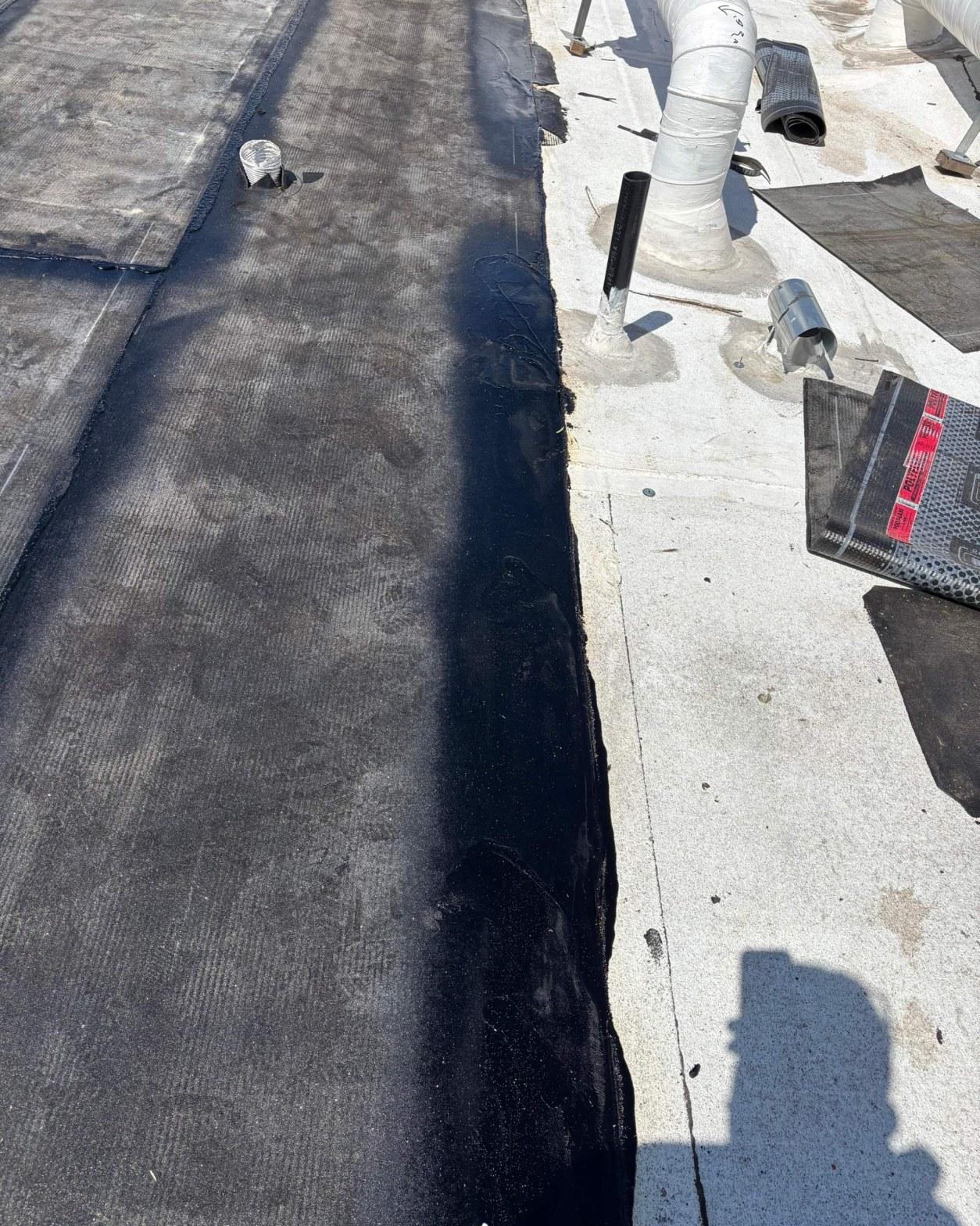
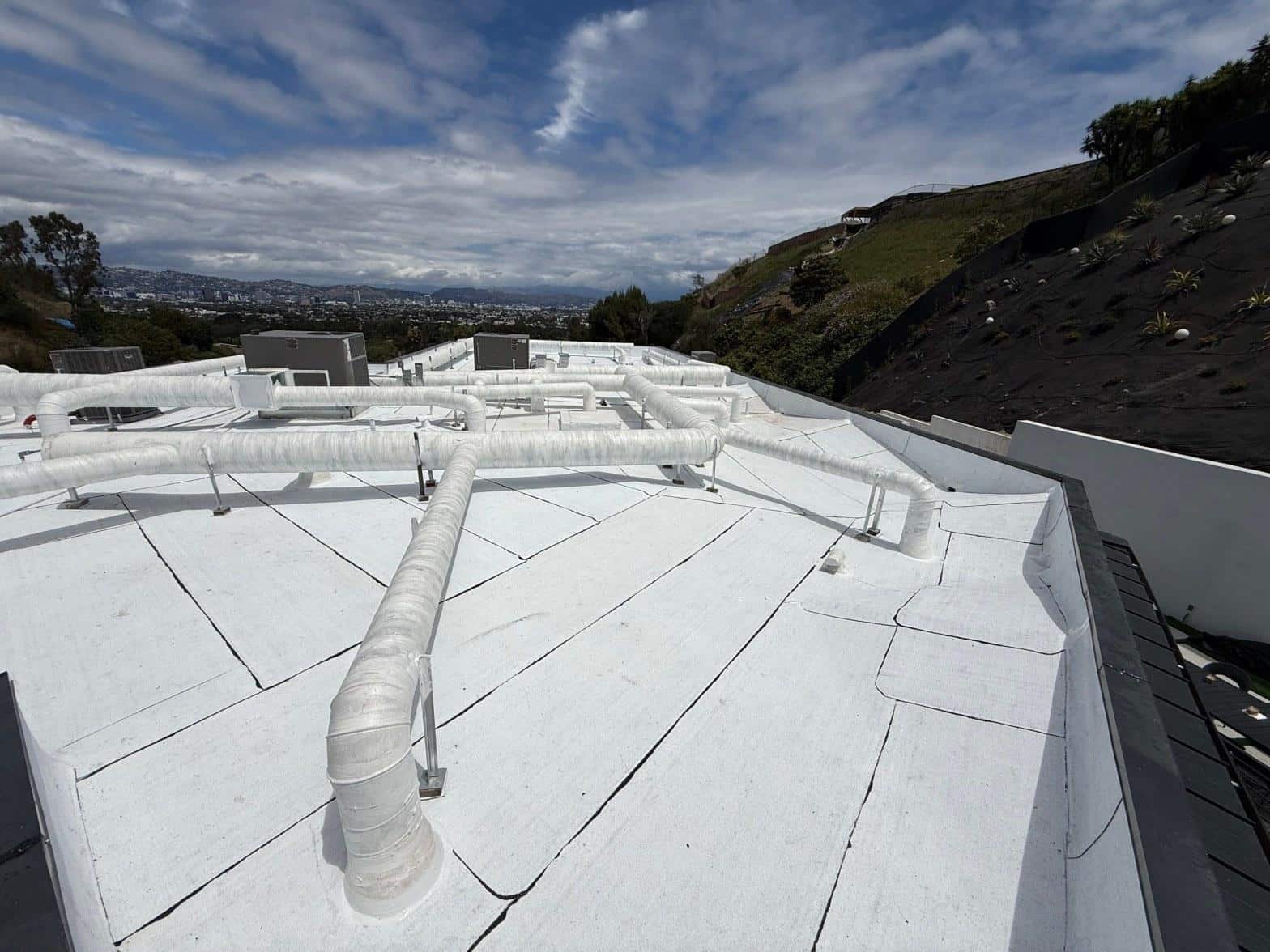
With the damaged decking replaced and the full surface cleaned back to a sound substrate, the new membrane went down in continuous rolls across the deck. The seams were staggered so no two joints aligned, and each roll was bonded to the one beside it with the overlap specified for the system. The penetrations, which had been the source of every earlier failure, were now detailed correctly: the membrane was brought up around each pipe fitting and terminated at a height that keeps standing water from ever reaching the bond line.
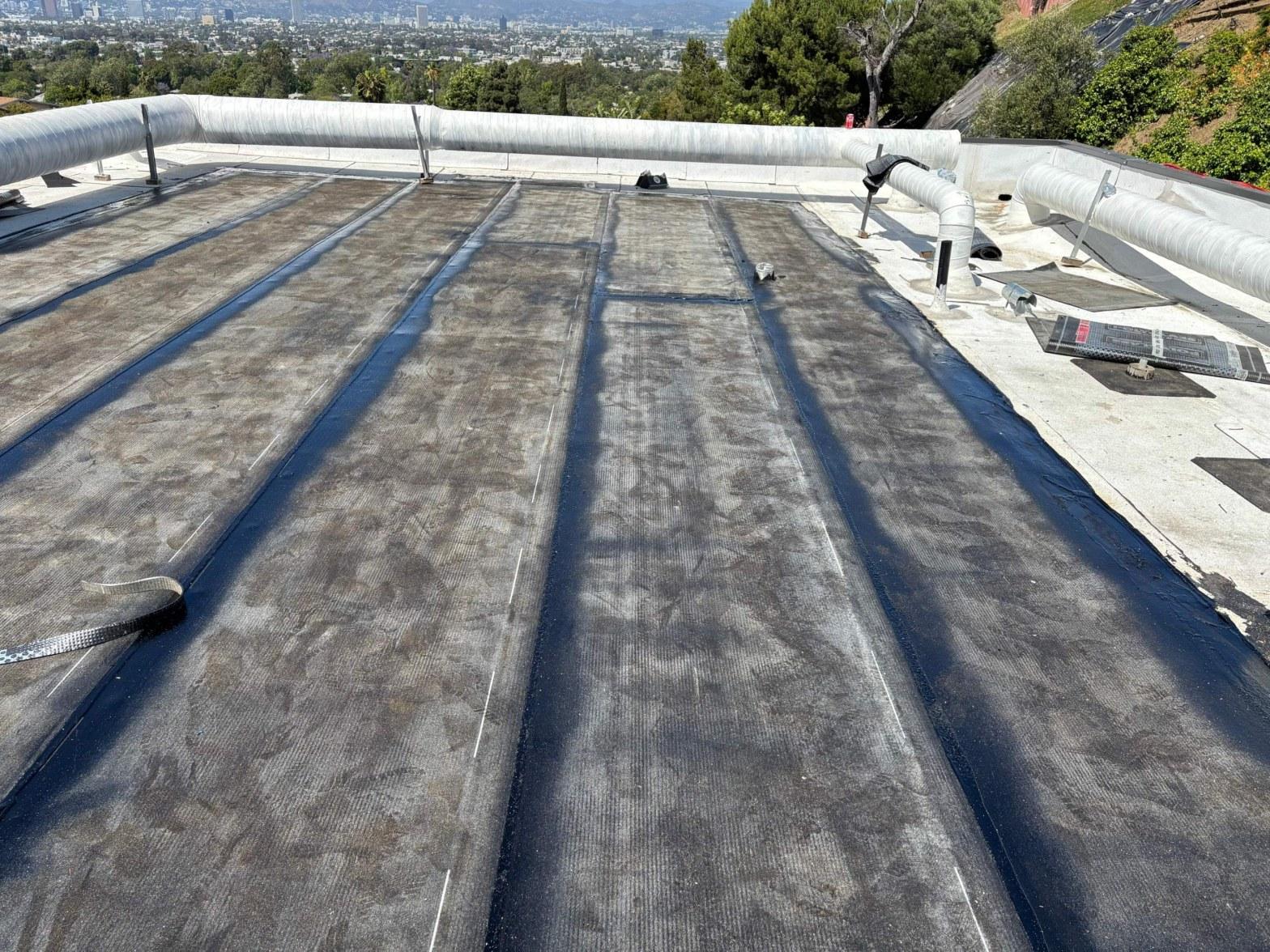
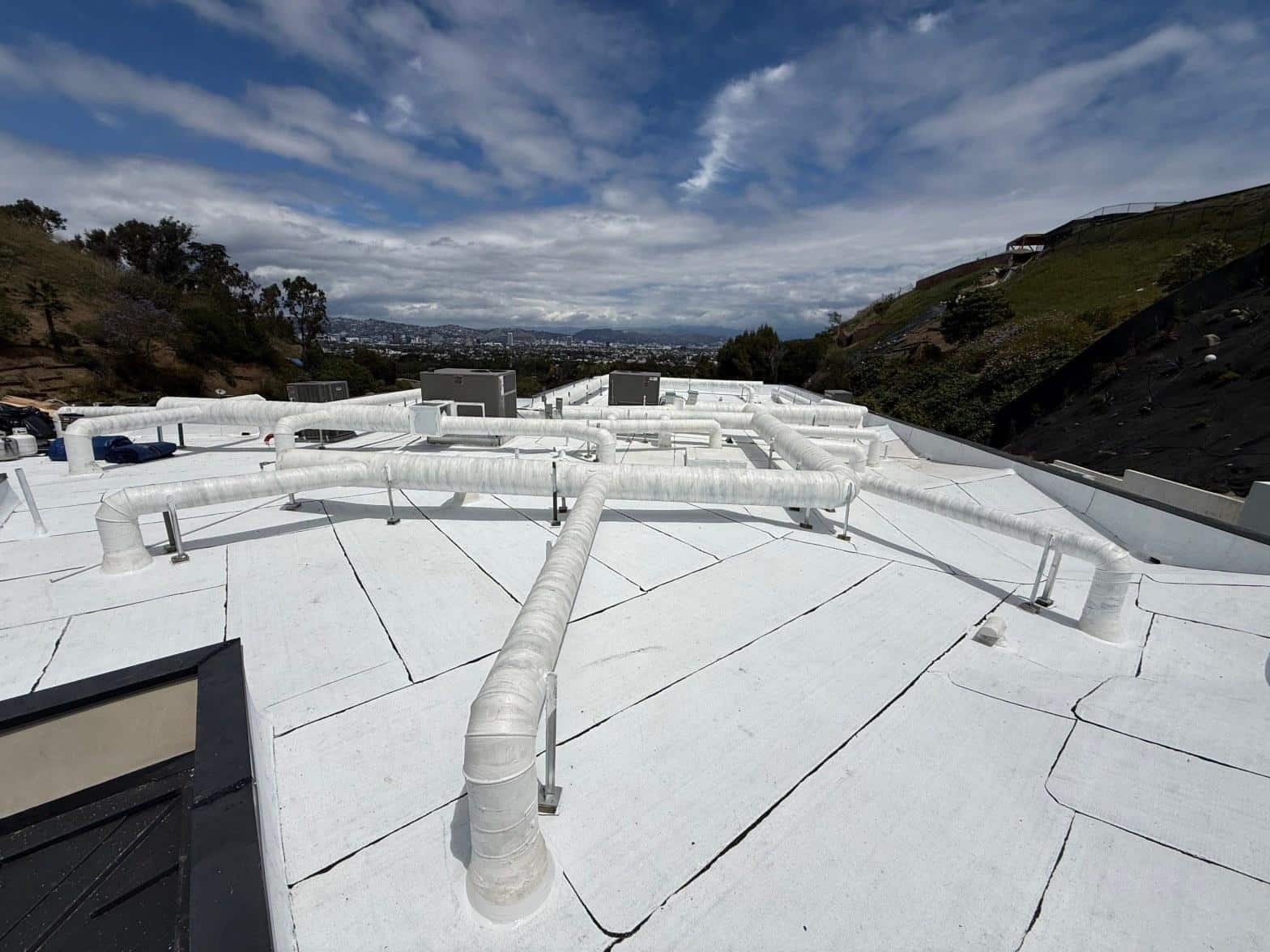
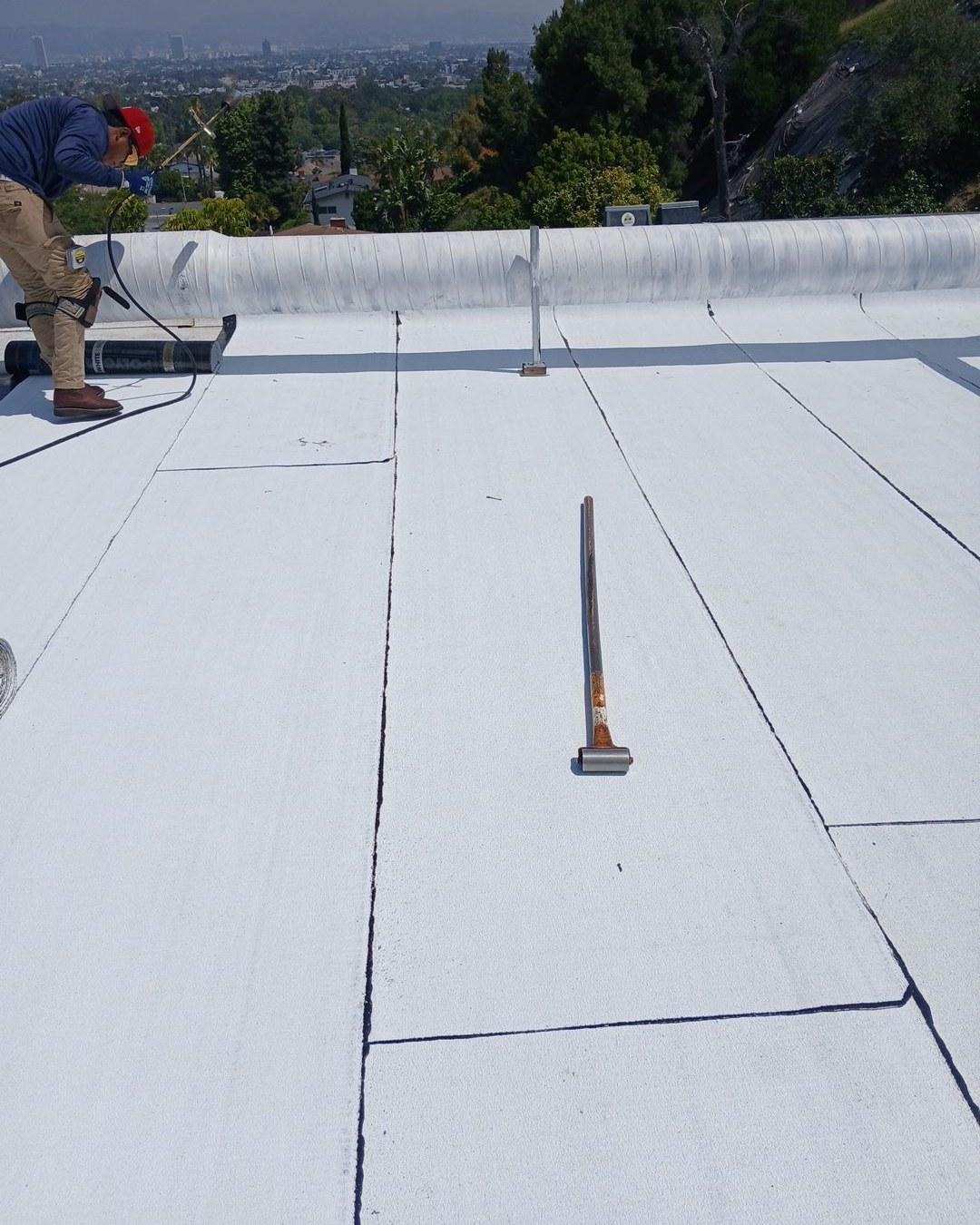
Once the membrane was down across the full deck, the white cap sheet followed. The cap sheet on a low-slope Los Angeles roof does two jobs. It protects the membrane layer beneath it from UV degradation, which is significant at this elevation and in this climate. It also reflects solar heat rather than absorbing it, which is consistent with the requirements that California’s Title 24 energy standards place on low-slope roof surfaces in climate zones across the state.
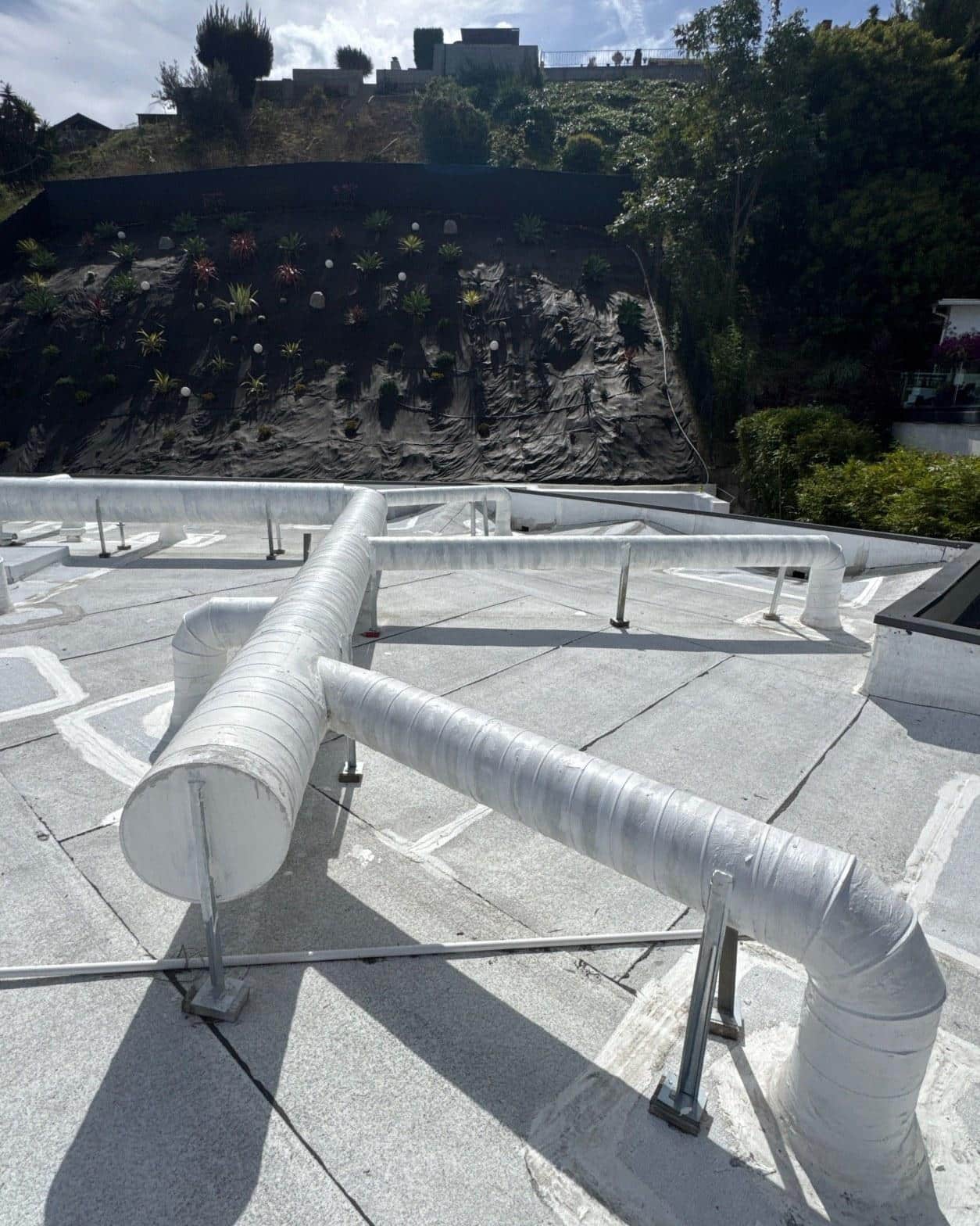
The rooftop HVAC units were reinstated through the new surface, and the insulated pipework was re-supported on new brackets above the cap sheet. Every penetration came back through a properly detailed collar rather than a ring of mastic. The result is a surface where the waterproofing is handled by the membrane, the UV protection is handled by the cap sheet, and the penetrations are sealed the way the system was designed to seal them.
The Finished Roof
The completed roof is uniform, clean, and free of the patched appearance that had defined the old surface for years. The white cap sheet reflects light evenly across the full deck, and the insulated pipework runs back from the equipment on properly elevated supports that keep it clear of the surface and allow water to drain freely around it.
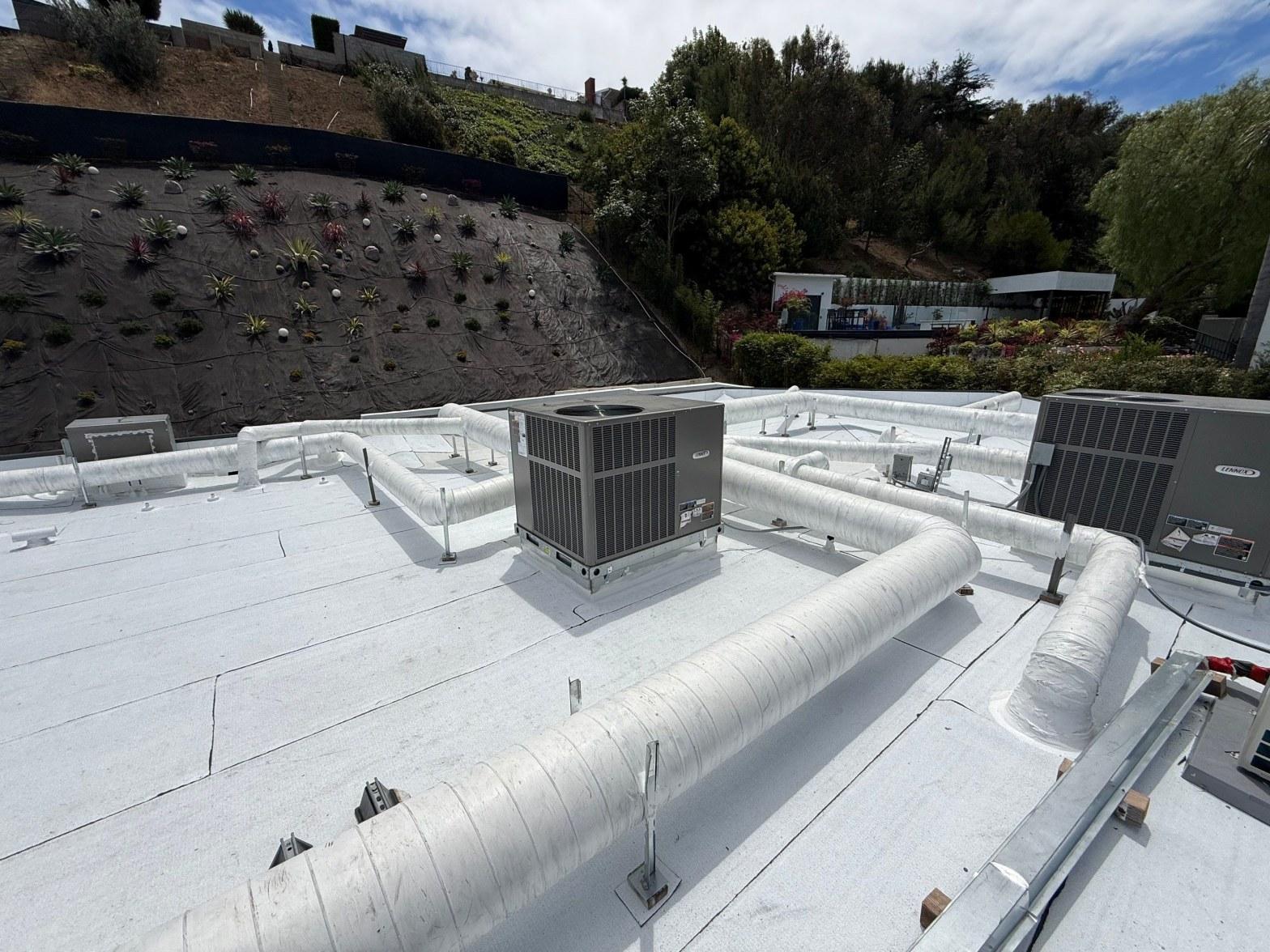
For the homeowner, the practical outcome is a roof where the penetrations are no longer the weak points. Each pipe and conduit now exits through a correctly installed flashing detail rather than a surface sealant applied over an existing breach. The cap sheet is new, the membrane below it is new, and the timber carrying both of them is sound.
Hollywood Contractor Corp is licensed by the California Contractors State License Board (CSLB), license number 1092628. If you have a low-slope or flat roof in the Los Angeles area that has been patched more than once, contact Hollywood Contractor Corp to schedule an assessment before the patches tell you what the timber underneath already knows.
Gallery
Explore our full range of General Contracting services.
Frequently Asked Questions
How often should I have my flat roof inspected if it already has some patches on it?
A flat roof with existing patches should be inspected at least once a year, ideally in fall before the rainy season in Los Angeles. Because a mastic repair can begin cracking long before the membrane around it does, an annual look at each penetration is the simplest way to catch a failing seal before it allows water into the deck timber below.
How do I know when patching my flat roof stops being worth it?
When patches are appearing in multiple locations across a single roof season, or when a patch applied not long ago is already cracking again, the membrane has likely aged past the point where surface repairs hold reliably. The more important question is what is happening to the timber underneath, because a patch hides the substrate and water damage there is invisible until the deck is opened.
Why do flat roofs leak more around pipes and vents than in the open areas?
The field of a flat roof membrane is a continuous sheet with no joints, so it has very few places where water can enter. Every pipe, vent, conduit, or equipment mount requires the membrane to be cut and fitted around an object that expands and contracts at a different rate than the roof itself. That movement eventually breaks down any sealant that is not properly integrated with the membrane layer, which is why penetrations account for the majority of flat roof leaks.
What is the difference between mastic and proper flashing on a flat roof penetration?
Mastic is a surface sealant that sits on top of the membrane and relies entirely on adhesion to stay watertight. A proper flashing detail brings the membrane material itself up around the pipe and bonds it, so the waterproofing is continuous rather than dependent on a secondary sealant. Mastic has a far shorter life than the membrane around it; a correctly detailed membrane flashing is designed to last the life of the roof system.
Does having more rooftop air conditioning equipment mean my flat roof needs more maintenance?
Yes, directly. Each rooftop unit requires multiple penetrations through the membrane for refrigerant lines, electrical conduits, and equipment supports, and each penetration is a point where the waterproofing has to be sealed around a fitting. A roof carrying several HVAC units and long runs of pipework has many more potential failure points than a plain roof of the same area, so the penetrations need to be checked regularly.
Can I see from the surface whether the timber under my flat roof is water damaged?
In most cases, no. A patch that is still holding will look intact from above even if the deck boards beneath it have softened from repeated moisture exposure. On the Los Angeles hillside job shown here, the surface appeared sealed right up until the patches were removed and the decayed timber was exposed. The only reliable way to assess the substrate is to open the roof at the locations where patches have been applied.