Accessible Bathroom Remodel: What to Know Now
Why Timing Matters for Your Accessible Bathroom Remodel in Pasadena
Every month you wait to start an home remodeling project brings new challenges and, often, higher bills. Accessible bathroom remodels are no exception. Material shortages have become more common, labor schedules fill up quickly, and California building codes are tightening enforcement around accessibility upgrades. Homeowners in established neighborhoods like Madison Heights and Old Town Pasadena are discovering that acting sooner rather than later not only makes financial sense—it may be the difference between staying in your home safely or being forced to relocate. This becomes especially urgent when mobility needs arise unexpectedly after a fall, surgery, or diagnosis.
📋 In This Guide
The cost of retrofitting an existing bathroom escalates when construction reveals outdated plumbing or structural issues that must be addressed first. And if you wait until a medical emergency forces the issue, you’ll likely pay a premium for rushed work. In 2026, more families in Pasadena are choosing to plan these renovations proactively, integrating ADA-compliant features and aging-in-place design principles before an urgent need arises. This listicle breaks down the most important considerations when budgeting and planning for an accessible bathroom remodel—from understanding California code requirements to identifying grant opportunities that can offset your expenses.
1. Understand the Difference Between Basic Accessibility and Full ADA Compliance
Not every accessible bathroom remodel needs to meet strict ADA standards, and understanding this distinction will shape both your project scope and budget. In new construction, access is required to all toilet rooms, but residential renovations offer more flexibility. ADA compliance applies mandatory specifications for clearances, fixture heights, and grab bar placements designed for public and commercial buildings. For a private home in Pasadena, you’re not legally required to meet these exact standards—but many homeowners choose to follow ADA guidelines because they represent a proven, safety-focused framework that improves bathroom accessibility for anyone with mobility limitations.
Even though ADA rules aren’t required in private homes, they provide the clearest framework for building a bathroom that is functional, safe, and future-proof. The biggest advantage of ADA-inspired design is resale value: a bathroom built to these specifications appeals to a much wider pool of buyers, especially as the population ages. In high-value Pasadena homes, where the median property is worth over $1 million, that flexibility translates directly to return on investment.
| Feature | Basic Accessibility | Full ADA Compliance |
|---|---|---|
| Doorway Width | 30 inches minimum | 32-36 inches clear opening |
| Toilet Height | 15-17 inches | 17-19 inches (comfort height) |
| Grab Bars | Basic wall-mounted bars | Reinforced blocking, specific placement specs |
| Turning Radius | Limited clearance | 60-inch minimum circle for wheelchair |
| Shower Entry | Low-threshold shower | Zero-threshold roll-in shower |
Many remodeling contractors in Pasadena recommend a hybrid approach: prioritize the features you need now (such as grab bars and a walk-in shower) while incorporating reinforcement and clearances that allow future upgrades without tearing out walls again. This strategy balances immediate safety needs with long-term adaptability.
2. Plan for Walk-In Shower Installation and Zero-Threshold Entry
The single most transformative upgrade in an accessible bathroom remodel is replacing a standard tub-shower combo with a walk-in or roll-in shower. A walk-in shower’s low threshold or curbless entry makes it easy to access for people with mobility limitations or disabilities. This modification eliminates the most dangerous obstacle in a traditional bathroom—the high curb you must step over while wet and off-balance.
A walk-in shower has a low threshold, typically 2 to 4 inches high, that allows for easy step-in access. This creates a secure, stress-free entry for bathers with limited mobility who may have difficulty lifting their legs over the high curb of a traditional shower-tub combo. For wheelchair users or anyone who relies on a walker, a zero-threshold or roll-in shower becomes essential. Roll-in showers are designed with a zero-threshold entry to allow easy, unobstructed access and maneuverability within the shower area. Their curb-free design ensures bathers using wheelchairs or mobility aids can enter safely and comfortably without needing a transfer seat.
What Installation Involves
Creating a curbless shower requires adjusting your bathroom floor to accommodate proper drainage slope. In older Pasadena homes, especially Craftsman-style houses in the Caltech Area, this can mean cutting into joists or installing a recessed shower pan—both of which add labor hours and material expense. However, the payoff is significant: you gain a spacious, modern shower that looks upscale while serving critical safety functions. Built-in benches, handheld showerheads, and slip-resistant tile complete the accessible design.
Tub-to-Shower Conversions
If your household includes young children or elderly family members who still prefer soaking, consider a walk-in tub with a shower attachment as an alternative. If you’re looking for the benefits of a walk-in tub with the ability to take a standing shower, consider a tub-shower combo. The hybrid design includes a shower head mounted above the tub for the best of both worlds. These hybrid systems work especially well in single-bathroom homes where versatility matters.
3. Install Reinforced Grab Bars in Strategic Locations
Grab bars are non-negotiable in an accessible bathroom, but not all grab bars are created equal. It is never enough to just screw a grab bar into standard drywall. The wall itself must have structural reinforcement (wood blocking or metal backing) capable of handling immense weight. A properly installed grab bar should support at least 250 pounds of force, which requires blocking installed during the framing phase or carefully retrofitted into existing walls.
ADA guidelines specify exact placement for grab bars around toilets and in showers, but for residential projects, the key is to install them where they’ll actually be used. Side wall bar (42 inches long) and rear wall bar (36 inches long), mounted 33 to 36 inches above the floor are the standard dimensions. In Pasadena homes with distinctive tile work or vintage finishes, many homeowners opt for designer grab bars in brushed nickel, oil-rubbed bronze, or matte black that blend seamlessly with the bathroom aesthetic rather than looking clinical.
Don’t overlook the shower area. Vertical and horizontal grab bars placed near the shower controls and along the wall opposite the showerhead give bathers multiple points of support. If you’re planning a zero-threshold shower, a fold-down bench paired with grab bars on both sides creates a secure seated bathing station that anyone in the household can use comfortably.
4. Choose Comfort-Height Toilets That Meet California Standards
Toilet seats in ADA-compliant bathrooms are typically between 17 and 19 inches above the finished floor to accommodate individuals with mobility challenges. Standard toilets sit at 14 to 15 inches, which can be difficult for anyone with knee or hip issues to use comfortably. “Comfort Height” is a term popularized by brands like Kohler to describe toilets with a seat height in the 17″–19″ range, similar to a standard chair.
These taller fixtures make sitting and standing significantly easier, which reduces fall risk and strain. A taller toilet is important for people with a number of physical disabilities, including those who suffer from knee injuries, arthritis in their knees or hips, need to transfer from a wheelchair, suffer from neuropathy, and more. For households in San Rafael or Madison Heights where multigenerational living is common, a comfort-height toilet serves everyone from aging parents to tall adults more effectively than a standard model.
When selecting a toilet, verify that it’s explicitly labeled as ADA-compliant rather than just “comfort height,” as some models marketed under that label fall slightly below the 17-inch minimum. Wall-mounted toilets are another option to consider: they provide the required clearance underneath for wheelchair foot space and simplify floor cleaning.
5. Widen Doorways and Improve Clearance for Wheelchair Access
Standard interior doors are 24–28 inches wide, which is too narrow for most wheelchairs and many walkers. We recommend a minimum 32-inch clear opening, with 36 inches being ideal. Widening a doorway is one of the more invasive modifications in an accessible remodel, as it often requires reframing the opening, relocating light switches, and patching drywall.
But this upgrade is essential if anyone in your household uses a mobility device now or may in the future. A standard hinged door that swings into the bathroom creates two problems: it blocks floor space when open, and if a senior falls against it, rescuers cannot push the door open. The three best alternatives are: Pocket door: Slides into the wall, reclaiming all floor space. Best for new construction or major remodels where wall modification is feasible. Barn doors and outswing doors are other solutions that improve accessibility without requiring wall cavity modifications.
Beyond the door itself, you need to ensure adequate maneuvering space inside the bathroom. Standard wheelchair-accessible stalls generally require a minimum 60-inch width and either a 56-inch depth (wall-mounted toilet) or 59-inch depth (floor-mounted toilet). This turning radius allows someone in a wheelchair to navigate the room independently—a critical factor for maintaining dignity and autonomy.
6. Incorporate Roll-Under Vanities for Seated Use
Traditional bathroom vanities have cabinets that extend all the way to the floor, making them impossible to use from a wheelchair. A roll-under or wall-mounted vanity solves this problem by providing knee clearance underneath the sink. This knee clearance must be 29 inches (735 mm) high at the front of the lavatory and no less than 27 inches (685 mm) high at a point 8 inches (205 mm) back. In addition, a minimum 9 inches (230 mm) high toe clearance must be provided.
These specifications ensure that someone seated in a wheelchair can pull up to the sink comfortably and reach the faucet without strain. Pair a roll-under vanity with lever-style faucet handles rather than knobs, as they require less grip strength and wrist mobility to operate. In Pasadena homes where design continuity matters, many contractors install floating vanities with concealed plumbing and integrated storage that maintains a clean, modern look while meeting accessibility requirements.
Consider adding electrical outlets at an accessible height (15 to 48 inches from the floor) and ensure the mirror is mounted low enough that someone seated can see their reflection. These small details add up to a bathroom that truly works for everyone, not just able-bodied users.
7. Explore California Grants, Tax Credits, and Financial Assistance
Accessible bathroom remodels represent a significant investment, but California offers multiple funding sources that can offset your expenses. California – Extended grants until June 2025, covering up to $5,000 for accessibility upgrades. While this program date has passed, similar state-level assistance continues to evolve, and checking with local Area Agencies on Aging can uncover current opportunities.
California offers a tax credit for homeowners who make their homes more accessible. This credit is designed to offset the cost of modifications that improve accessibility for people with disabilities or those who are aging in place. Qualifying Improvements: Eligible improvements include installing ramps, modifying bathrooms, widening doorways, and adding stairlifts. The homeowner qualifies for a state tax credit of 20% of the improvement costs, or $2,400, reducing their California state tax liability.
Federal Deductions and Veterans Benefits
Out-of-pocket expenses for a range of accessibility modifications can be included when calculating federal income tax medical expense deductions. To qualify, the modifications must be deemed medically necessary by a healthcare provider, and your total medical expenses must exceed 7.5% of your adjusted gross income. This threshold is often met when bathroom renovations are combined with other healthcare costs in a given tax year.
Veterans have additional resources. Home Improvements and Structural Alterations (HISA) Grant: This grant pays up to $6,800 in lifetime benefits for veterans with at least a 50% VA disability rating to improve accessibility and use of the home. The VA also offers Specially Adapted Housing (SAH) and Special Home Adaptation (SHA) grants for more extensive modifications.
Local Programs in Los Angeles County
In Los Angeles County, these programs help low-income homeowners reduce or defer property taxes for approved safety repairs. Contact your local community development office to learn about current loan programs, repair grants, and property tax relief options specific to Pasadena and surrounding areas.
8. Balance Medical Necessity with Resale Value
One of the most common concerns homeowners express when planning an accessible bathroom remodel is whether the changes will hurt resale value. The answer depends on how you execute the design. A bathroom that looks institutional or overly medical will be a harder sell to general buyers, but one that incorporates universal design principles—features that benefit everyone regardless of age or ability—can actually increase your home’s appeal.
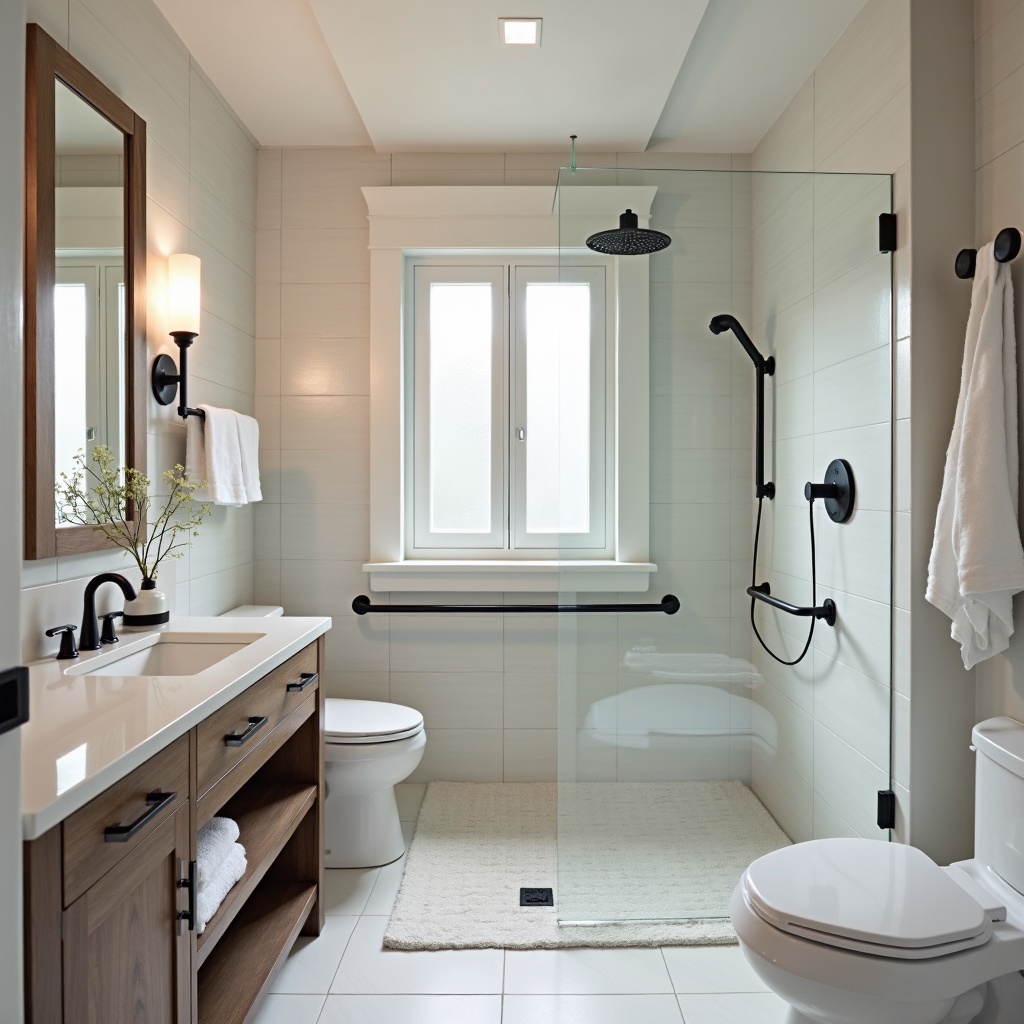
In fact, 2026 trends focus on “Invisible Accessibility”—features that look like high-end spa upgrades but function as vital safety measures. For many homeowners in San Marino and South Pasadena, the first step is a curbless shower installation. A zero-threshold shower with large-format tile, frameless glass panels, and a linear drain reads as contemporary luxury design to most buyers, not as a medical modification.
Similarly, grab bars no longer need to resemble hospital equipment. Manufacturers now offer models in designer finishes that double as towel bars or decorative accents. Comfort-height toilets have become so standard in new construction that many buyers expect them. And roll-under vanities, when designed with floating cabinets and integrated lighting, look like intentional modern design choices.
The key is to work with a home improvement contractor who understands both accessibility requirements and contemporary design trends. By selecting materials, finishes, and fixtures that serve dual purposes—beautiful and functional—you create a bathroom that ages gracefully alongside your household while maintaining broad market appeal.
9. Prioritize Slip-Resistant Flooring and Proper Lighting
ADA compliance requires flooring with 0.6 static coefficient of friction, effectively meaning “non-slip”. This specification is critical in a bathroom where water, soap, and steam create inherently slippery conditions. Porcelain tile with a textured finish, slip-resistant vinyl, and natural stone with a honed rather than polished surface all meet this requirement while offering diverse aesthetic options.
Mobility and accessibility improvements and bathroom safety enhancements were implemented in all studies (100%), including threshold removal, doorway widening, stair lift installation, grab bars, and non-slip mats. Fall prevention measures were applied in 18 studies (90%), incorporating non-slip flooring, lighting improvements, and mobility training. These evidence-based interventions demonstrate that flooring and lighting work together to reduce fall risk.
Install bright LED lighting throughout the bathroom, with particular attention to task lighting near the vanity and shower. Motion-activated nightlights are inexpensive additions that dramatically improve safety during nighttime bathroom visits—a time when falls are most likely to occur. Consider adding a dimmer switch so users can adjust light levels based on time of day and personal preference.
In older Pasadena homes where vintage fixtures and finishes are part of the property’s charm, finding slip-resistant materials that complement existing design can be challenging. Work with a contractor experienced in historic renovations who can source period-appropriate materials engineered for modern safety standards.
10. Work with Licensed Contractors Who Understand California Code Requirements
California has some of the most stringent building codes in the nation, and accessibility modifications must comply with both state and local requirements. When an existing restroom is altered, the altered elements must comply with the 2010 ADA Standards to the maximum extent feasible. If replacing partitions in an existing restroom, the new partitions must include an ADA-compliant accessible stall if one does not already exist. The “maximum extent feasible” qualifier applies when existing structural conditions (immovable walls, plumbing locations, structural columns) make full compliance physically impossible—not merely expensive or inconvenient.
This is why working with a licensed remodeling contractor who specializes in accessible design is essential. They understand how to navigate permit requirements, identify structural constraints early in the planning process, and propose solutions that meet code without compromising your home’s integrity or character. A contractor familiar with Pasadena’s older housing stock will anticipate common issues like outdated electrical systems, cast-iron plumbing, and foundation settling that can complicate accessibility retrofits.
Before work begins, request a detailed written estimate that breaks down labor, materials, and permit fees. Ask about their experience with accessible bathrooms specifically, and request references from past clients who completed similar projects. A quality contractor will also discuss phasing options if budget constraints require spreading the work over multiple stages.
At Hollywood Contractor Corp, we specialize in accessible bathroom remodels that balance California code compliance with homeowner preferences and budget realities. Whether you’re planning a complete renovation or targeted upgrades like grab bar installation and comfort-height toilet replacement, our team brings decades of experience to every project. We serve homeowners throughout Pasadena, La Crescenta, and North Hollywood, helping families create bathrooms that support independent living for years to come. Call us at (818) 264-1955 to schedule a free consultation and discuss your accessible bathroom remodel.

Adolfo Ramos is the owner and founder of Hollywood Contractor Corp, serving the San Fernando Valley with comprehensive remodeling and roofing services. With over fifteen years of hands-on construction experience, he has built a reputation for quality craftsmanship and reliable service throughout Burbank, La Crescenta, Pasadena, and North Hollywood. Adolfo takes pride in transforming homes while maintaining the highest standards of safety and customer satisfaction.
❓ Frequently Asked Questions
How much does an accessible bathroom remodel typically involve in modifications?
An accessible bathroom remodel in Pasadena typically includes walk-in shower installation, reinforced grab bars, comfort-height toilets, widened doorways (32-36 inches), roll-under vanities, and slip-resistant flooring. The scope depends on whether you're pursuing basic accessibility upgrades or full ADA compliance. Contact Hollywood Contractor Corp at (818) 264-1955 for a detailed assessment.
Can I claim tax deductions for accessibility modifications in California?
Yes. California offers a tax credit of up to 20% of accessibility improvement costs for homeowners making medically necessary modifications. Federally, you may deduct accessibility expenses as medical deductions if they exceed 7.5% of your adjusted gross income and are prescribed by a healthcare provider. Keep all receipts and consult a tax professional.
What is the difference between a walk-in shower and a roll-in shower?
A walk-in shower has a low threshold (2-4 inches) for easy step-in access, while a roll-in shower features zero-threshold entry, allowing wheelchair users to roll directly into the shower without any barrier. Roll-in showers provide the highest level of accessibility but require more extensive floor modifications to accommodate proper drainage slope.
Will adding ADA features hurt my home's resale value in Pasadena?
Not if designed well. Universal design features like curbless showers, comfort-height toilets, and designer grab bars appeal to buyers of all ages and abilities. In Pasadena's high-value market, bathrooms that blend accessibility with contemporary design aesthetics often increase resale appeal, especially as the population ages and multigenerational living becomes more common.
📖 More Tips for Pasadena
-
 Hidden Roof Replacement Costs
Why Understanding Hidden Roof Replacement Costs Matters Right NowWhen planning a roof replacement in Pasadena, most homeowners focus…
-
 Kitchen Remodel Cost Guide: Pasadena Homeowner FAQ
Discover what Pasadena homeowners get wrong about kitchen remodeling budgets and learn the real costs behind cabinets, countertops,…
-
 Bathroom Ventilation & Moisture Control in Pasadena
Proper bathroom ventilation protects Pasadena homes from costly mold damage and code violations. Learn CFM sizing, humidity controls,…
-
 Title 24 Compliance for Home Additions
A home addition in Pasadena must meet California's Title 24 energy standards, which require upgraded insulation, high-performance windows,…